

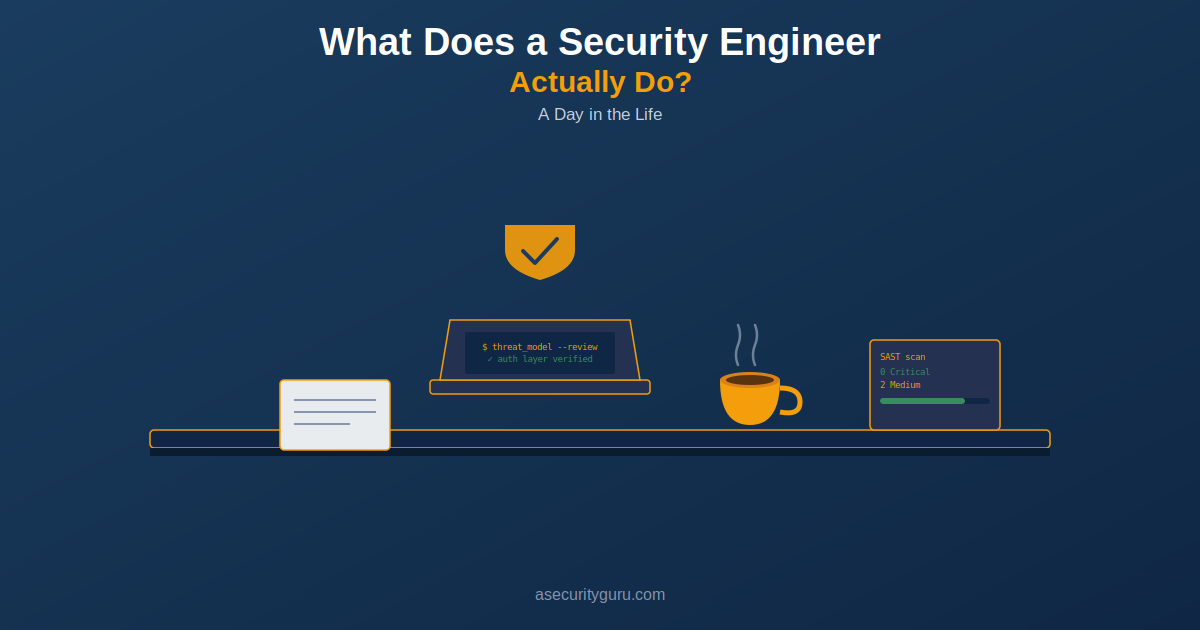
My wife assumes that my day starts with an alert and ends with catching a hacker. But if you are a security engineer, you already know the truth. Most days it starts with the commute to the office and then drinking coffee. Once I am recharged, I start with a design review, then trying to convince a team to add authentication (mTLS) to an internal API before it ships, not after. As many of us wonder, What does a security engineer do? Let’s now answer this question in detail.
Cybersecurity is often portrayed as a straightforward conflict — attackers versus defenders, headlines full of ransomware and breaches and skilled criminals racing against equally skilled defenders. A security engineer’s actual day looks nothing like that. The real goal isn’t just stopping attacks as they happen — it’s building systems that are safe, reliable, and resilient enough that most attacks never get anywhere close to succeeding in the first place.
As companies rapidly adopt cloud computing, DevOps, AI, and distributed architectures, security engineers have become essential collaborators in software development rather than gatekeepers standing at the end of the pipeline. Integrating security into every phase of the development lifecycle is what lets organizations innovate safely, instead of security being the thing that slows everyone down.
The Security Engineer’s Mindset
Security engineering puts far more emphasis on prevention through design than traditional security operations, which tend to focus on detection and response after something has already gone wrong.
| Traditional Security | Security Engineering |
|---|---|
| Reacts to incidents | Prevents incidents through secure design |
| Focuses on alerts | Focuses on system architecture |
| Finds vulnerabilities | Eliminates root causes |
| Deploys security tools | Integrates security into development |
| Works after deployment | Works throughout the SDLC |
A security engineer’s primary responsibility is reducing risk before software ever reaches production — which is exactly why so much of the actual day happens in design reviews and architecture discussions, not incident response.
Security Is About Context, Not Just Vulnerability Counts
Modern vulnerability scanners can surface thousands of findings within minutes. But not every vulnerability carries the same real-world danger, and a huge part of the job is figuring out which ones actually matter.
Before prioritizing anything, a security engineer is asking questions like:
- Does the application have an internet-facing interface?
- Does it store sensitive customer data?
- Is this a known, well-documented vulnerability?
- Is it realistically exploitable in this specific environment?
- Do compensating security controls already reduce the risk?
Risk-based prioritization typically weighs five factors:
| Factor | Why It Matters |
|---|---|
| Business Impact | Determines potential financial or operational damage |
| Exploitability | Measures how easily attackers can actually exploit the issue |
| Asset Criticality | Identifies whether critical systems are affected |
| Existing Controls | Determines whether the risk is already partially mitigated |
| Compliance Impact | Considers legal and regulatory consequences |
This is where a good chunk of the actual workday goes — not chasing every finding a scanner produces, but deciding which ten out of a thousand actually deserve attention this week.
Secure by Design: The Work Starts Before Any Code Is Written
One of the most common mistakes organizations make is treating security as the final testing stage before launch. That reactive approach tends to produce costly redesigns, delayed deployments, and vulnerabilities that could have been avoided entirely if they’d been caught during design instead of after deployment.
Secure by Design flips that order — security gets built into a system from the very first architecture conversation, not added as a restriction afterward. Authentication, authorization, encryption, logging, and data protection become core parts of the architecture itself, rather than constraints bolted onto a finished product. Catching and fixing issues this early dramatically lowers remediation costs and produces genuinely more resilient software.
| SDLC Phase | Security Activities |
|---|---|
| Planning | Threat modeling, risk assessment |
| Design | Secure architecture, Zero Trust principles |
| Development | Secure coding, code reviews, dependency scanning |
| Testing | SAST, DAST, penetration testing |
| Deployment | Infrastructure validation, secrets management |
| Operations | Monitoring, logging, incident response |
A day spent in the Planning or Design column looks completely different from a day spent in Operations — which is part of why “what does a security engineer do” doesn’t really have a single answer.
Security Engineering Is a Team Sport
No single department owns cybersecurity anymore. Protecting modern applications and infrastructure takes close coordination across the whole company, and a security engineer spends a real portion of the week simply talking to other teams: helping infrastructure teams roll out network segmentation and Zero Trust architecture, working with DevOps to build automated security checks into CI/CD pipelines, helping cloud engineers harden their environments, and working directly with developers on secure coding practices day to day.
There’s also a communication layer that doesn’t show up in most job descriptions — translating technical risk into terms business leaders can actually act on, so that investment and risk decisions get made with real information behind them. The most effective security engineers combine solid technical depth with genuinely good communication, functioning as trusted advisors rather than just a team that says no.
Core Principles, Applied Daily
The fundamental ideas in security haven’t changed much even as the technology around them moves fast. Security engineers lean on a small set of proven principles — Least Privilege, Defense in Depth, Secure by Default, Zero Trust, Fail Securely, and Continuous Monitoring — to guide decisions across identity management, network security, application development, and cloud infrastructure. For a full breakdown of these principles and how they connect to real threat modeling, see Core Security Principles Every Engineer Should Know.
How AI Is Changing the Job
AI is reshaping this role from both directions. Attackers are already using AI to build malware variants faster, automate reconnaissance, generate convincing phishing content, and run large-scale social engineering campaigns. Defenders are using the same underlying technology to prioritize alerts, detect anomalies, automate threat hunting, and speed up incident investigation.
That shift is expanding the job itself. Security engineers increasingly need to secure AI models, training data, APIs, memory systems, and autonomous AI agents — not just traditional applications and infrastructure — while defending against threats like prompt injection, data poisoning, model theft, and adversarial input. For the deeper breakdown of what this actually looks like in practice, see AI Security 101 and Threat Modeling for Agentic AI.
What’s Actually in the Toolkit
The day-to-day toolkit spans several categories. Identity and Access Management (IAM), Multi-Factor Authentication (MFA), and Privileged Access Management (PAM) cover identity security. SAST, DAST, and Software Composition Analysis (SCA) help catch vulnerabilities during development. Cloud security platforms, container security tools, SIEM, SOAR, and Endpoint Detection and Response (EDR) provide visibility and automated response across infrastructure. And increasingly, specialized AI security tools for model monitoring, prompt protection, and governance are becoming a standard part of the kit.
Raghu’s Expert Take
In the traditional security engineer role, I used to run SAST, SCA and DAST scan assessments while working with Dev team to identify True positives and fixing these vulnerabilities. But after moving to security engineering, I work on reviewing architectures, identifying weakness in these designs and then suggesting security controls like mTLS, ALE (Application-Level Encryption), and payload encryption to the teams implementing the designs in the organization.
Frequently Asked Questions
Is a security engineer the same thing as a penetration tester? No, though the roles overlap. Penetration testers actively try to break into systems to find vulnerabilities. Security engineers design and build the systems, processes, and controls that prevent those vulnerabilities from existing in the first place — prevention through design rather than testing after the fact.
Does a security engineer need to know how to code? Generally, yes, at least well enough to review code, understand secure coding practices, and communicate credibly with developers. The depth varies by organization, but strong technical fluency is what makes the “trusted advisor” part of the role actually work.
What’s the difference between a SOC analyst and a security engineer? A SOC (Security Operations Center) analyst typically focuses on monitoring, detecting, and responding to active threats — reactive, operational work. A security engineer focuses more on designing and building secure systems before they reach production — proactive, architectural work. Many security engineers have SOC experience earlier in their careers.
How much of the job is actually spent stopping hackers? Less than people expect. A lot of the real work is design reviews, risk prioritization, cross-team collaboration, and building security into pipelines and architecture — the parts that make attacks harder to succeed in the first place, rather than dramatic real-time defense.
Is security engineering a good career path right now? Yes — demand continues to grow, particularly as organizations adopt cloud, DevOps, and AI at a pace that outstrips their in-house security expertise. The AI security specialization specifically is an area with a significant and growing talent gap.
Next Steps
For a deeper look at the principles referenced throughout this post, read Core Security Principles Every Engineer Should Know and The CIA Triad Explained. If AI security is where you want to specialize, start with AI Security 101.
For structured, hands-on learning across DevSecOps, Application Security, and AI Security, explore Raghu’s courses on Udemy.
Sources and References
- NIST Secure Software Development Framework (SSDF) — federal reference for secure-by-design SDLC practices
- OWASP Top 10 for Large Language Model Applications — AI-specific threats referenced in this post
- ASecurityGuru: Core Security Principles Every Engineer Should Know
- ASecurityGuru: AI Security 101
Raghu the Security Expert has 20 years of experience in Security, DevSecOps, AI Security, and Penetration Testing. He has helped 80,000+ students upskill themselves in DevSecOps, Application Security, and AI Security. Follow his work on LinkedIn, YouTube, and Udemy.
That sounds really interesting – I’ve been reading about threat modeling and it seems like a crucial part of the job.