

I was working for a Banking organization and the entire team made sure that our system is available 99.99% of the time which is good but the Highly confidential data was being sent without payload encryption over the APIs and TLS termination was happening at an intermediate party, which is a clear breach of Confidentiality principle. I was shocked to see that more weight was given to Availability rather than confidentiality. Hence, if you want to learn how to create a balance between Confidentiality, Integrity and Availability then keep reading.
Every cybersecurity framework, every security policy, and every risk assessment eventually comes back to three core questions: Is the data protected from the wrong eyes? Is it accurate and untampered? Can the right people access it when they need it? These three questions are the CIA Triad — Confidentiality, Integrity, and Availability — and they form the foundation of everything in information security.
Whether you work in a hospital, a bank, a government agency, or a startup, every security decision you make is implicitly a tradeoff between these three principles. Understanding them clearly is what separates a security engineer who patches vulnerabilities from one who designs systems that are genuinely secure.
What Is the CIA Triad?
The CIA Triad is a security model used to evaluate and strengthen the protection of information assets. Rather than focusing on one aspect of security in isolation, it takes a balanced approach: ensuring that data is protected from unauthorized access, remains accurate and reliable, and is accessible whenever legitimate users need it.
The three components — Confidentiality, Integrity, and Availability — are interdependent. Improving one without considering the others creates new risks. Overly strict access controls (confidentiality) can break system availability. Prioritizing uptime (availability) at the expense of access controls weakens confidentiality. Getting this balance right is the actual challenge.
Confidentiality
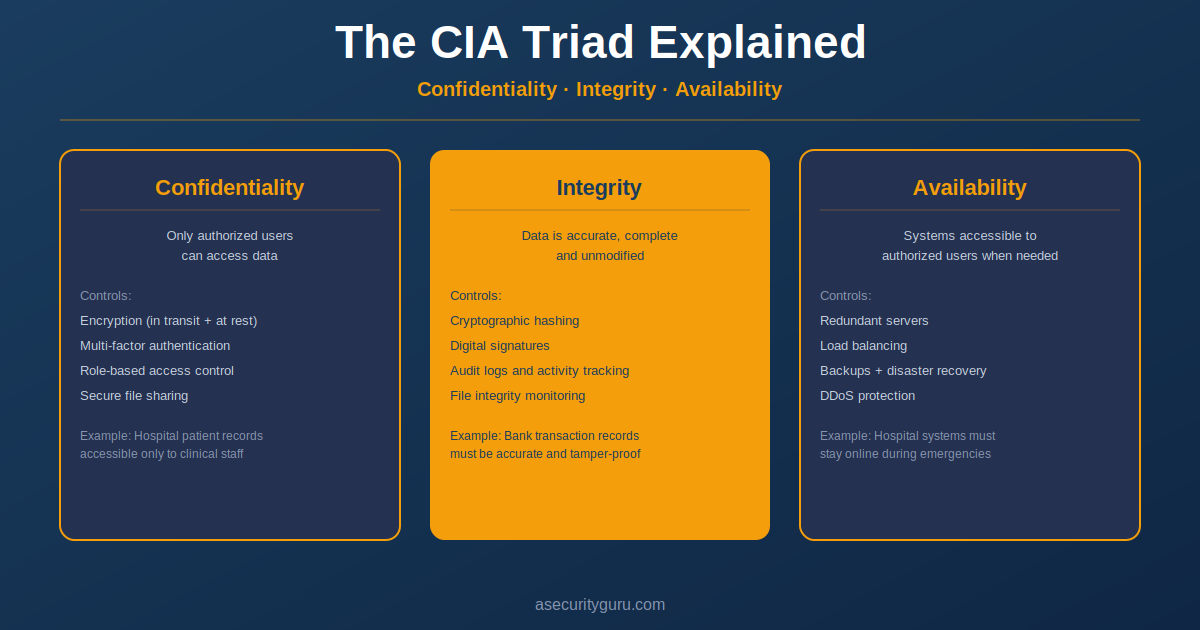
Confidentiality is about ensuring that sensitive information is accessible only to those who are authorized to see it. The goal is to prevent unauthorized access, disclosure, or exposure — whether through external attacks, insider misuse, or accidental leakage.
Organizations hold vast amounts of sensitive data: customer records, financial information, employee details, intellectual property, and strategic plans. If this information reaches the wrong hands — through a breach, a misconfiguration, or a phishing attack — the consequences include financial loss, legal liability, and lasting reputational damage.
Common controls for maintaining confidentiality:
- Encryption for data in transit and at rest
- Multi-factor authentication (MFA)
- Role-based access control (RBAC) — ensuring people can only access what their role requires
- Secure file sharing and communication channels
- Security awareness training
Real-world example: In a hospital, a patient’s medical records should only be accessible to the treating physician and directly involved clinical staff. Limiting access isn’t just good security — it’s a legal requirement under regulations like HIPAA. A misconfigured database that exposes those records to all hospital staff is a confidentiality failure, even if no external attacker was involved.
Integrity
Integrity ensures that data is accurate, complete, and unmodified — and that any unauthorized changes are detected and prevented. It’s not enough for data to exist; it has to be trustworthy.
Compromised data integrity is sometimes harder to detect than a confidentiality breach. A leaked password is obvious once discovered. But subtly modified financial records, altered log files, or tampered transaction data can go unnoticed for months — and by then, decisions have been made based on corrupted information.
Common controls for maintaining integrity:
- Cryptographic hashing — generating a fingerprint of data that changes if the data is tampered with
- Digital signatures — verifying both the authenticity and integrity of a document or message
- Audit logs and activity tracking — creating an immutable record of who changed what, and when
- Version control systems — tracking changes to code or documents over time
- File integrity monitoring — alerting when critical system files are modified
- Regular backups and data validation
Real-world example: In online banking, customers trust that their account balance and transaction history are accurate. If a threat actor modified transaction records — redirecting payments or altering balances — customers and the bank would make decisions based on false data. Integrity controls detect and prevent exactly this kind of manipulation.
Availability
Availability ensures that systems, applications, and data are accessible to authorized users when they need them. A system that is perfectly confidential and perfectly accurate but routinely unreachable is not a secure system — it has failed its users.
Threats to availability include DDoS (Distributed Denial-of-Service) attacks, hardware failures, software bugs, power outages, and natural disasters. Any of these can take a critical system offline at exactly the wrong moment.
Common controls for maintaining availability:
- Redundant servers and network infrastructure
- Load balancing — distributing traffic so no single server becomes a bottleneck
- Data backups and disaster recovery plans
- Cloud-based failover solutions
- Regular system maintenance and patch management
- Continuous system monitoring and alerting
Real-world example: A hospital’s patient management system going offline during an emergency is not just an IT problem — it’s a patient safety issue. A financial trading platform going down during peak trading hours can mean millions in losses. Availability isn’t just convenient; for many organizations it’s critical to operations and safety.
Balancing All Three
The real skill in applying the CIA Triad is recognizing that all three components must be balanced — and that improving one can undermine another if done carelessly.
- Strict access controls improve confidentiality but can limit availability if they’re too aggressive — locking out authorized users during critical moments
- Maximizing uptime and availability can lead to shortcuts in access control and authentication that erode confidentiality
- Fast, frictionless data sharing improves availability but can compromise both confidentiality and integrity if not properly controlled
A well-designed security posture gets this balance right for the specific risk profile of the organization. A hospital prioritizes availability and confidentiality differently than a bank; a startup operates under different constraints than a government agency. The CIA Triad doesn’t prescribe a single answer — it gives you the framework to find the right one for your context.
How the CIA Triad and AAA Framework Work Together
The CIA Triad defines what your security goals are. The AAA framework — Authentication, Authorization, and Accounting — defines how those goals are enforced in practice.
- Authentication verifies identity (who are you?) — directly supports Confidentiality
- Authorization controls access (what are you allowed to do?) — directly supports Integrity and Confidentiality
- Accounting records activity (what did you do, and when?) — directly supports Integrity and provides an audit trail
Here’s how I explain the relationship to my students — think of CIA as what you’re protecting, and AAA as how you enforce that protection:
| Aspect | CIA Triad | AAA Framework |
|---|---|---|
| Purpose | Defines the core goals of information security | Defines how users access systems and how activity is controlled |
| Focus | Protecting data and ensuring its security | Managing user identity, permissions, and accountability |
| Main Components | Confidentiality, Integrity, Availability | Authentication, Authorization, Accounting |
| Confidentiality / Authentication | Ensures sensitive data is accessible only to authorized individuals | Verifies the identity of a user, device, or process before granting access |
| Integrity / Authorization | Ensures data remains accurate and unaltered by unauthorized parties | Determines what resources and actions an authenticated user is permitted |
| Availability / Accounting | Ensures systems and data are accessible to authorized users when needed | Records and monitors user activity for auditing, compliance, and troubleshooting |
In practice: you achieve confidentiality by using authentication and authorization to prevent unauthorized access. You support integrity through authorization controls (only the right people can modify data) and accounting (a log of every change). You protect availability by ensuring the AAA mechanisms themselves don’t become bottlenecks that lock out legitimate users.
Raghu’s Expert Take
In my experience, Confidentiality is the most neglected of the three because teams think that only TLS is enough to send Highly Confidential data on the APIs which is not. When the data gets leaked, then they realize too late that TLS only protects data in transit so when TLS termination happens, it is very important to review where this termination happens and is our data encrypted after the termination or not. If the place where TLS termination happens is not trusted then data should be encrypted even after TLS termination happens.
Frequently Asked Questions
Is the CIA Triad the same as the CIA (intelligence agency)? No — this is a common point of confusion. The CIA Triad stands for Confidentiality, Integrity, and Availability. It has nothing to do with the Central Intelligence Agency and predates most modern cybersecurity frameworks.
Why is it called a “triad” and not just “three principles”? Because the three elements are interdependent, not independent. A triad implies a unified, interconnected model — improving one affects the others. You can’t treat them as separate checkboxes; they have to be balanced as a whole.
Can one principle be more important than the others? It depends on the context. For a hospital, availability may be the highest priority (systems going offline can endanger lives). For a law firm, confidentiality may be paramount (client privilege is legally mandated). For a financial institution, integrity may be the primary concern (any modification to financial data is potentially fraudulent). The CIA Triad doesn’t rank the three — it asks you to identify the right balance for your specific situation.
What happens when the CIA Triad fails? A breach of confidentiality results in unauthorized data exposure. A breach of integrity results in tampered or corrupted data that can no longer be trusted. A breach of availability results in systems being inaccessible — whether through a DDoS attack, ransomware, or hardware failure. Real-world attacks often target more than one: ransomware typically attacks both integrity (encrypting/corrupting data) and availability (making systems inaccessible) simultaneously.
How does the CIA Triad relate to compliance frameworks like ISO 27001 or NIST CSF? The CIA Triad underpins most major security frameworks. ISO 27001 explicitly references confidentiality, integrity, and availability as the core objectives of its information security management system. The NIST Cybersecurity Framework’s functions (Identify, Protect, Detect, Respond, Recover) are all oriented around maintaining these three properties. Learning the CIA Triad first makes every other framework easier to understand.
Next Steps
The CIA Triad is the foundation — but it’s just the starting point. To go deeper into how these principles apply in practice:
- What Is Cybersecurity? — the broader landscape these principles operate within
- Types of Cybersecurity Domains — how the CIA Triad maps onto specific security specializations
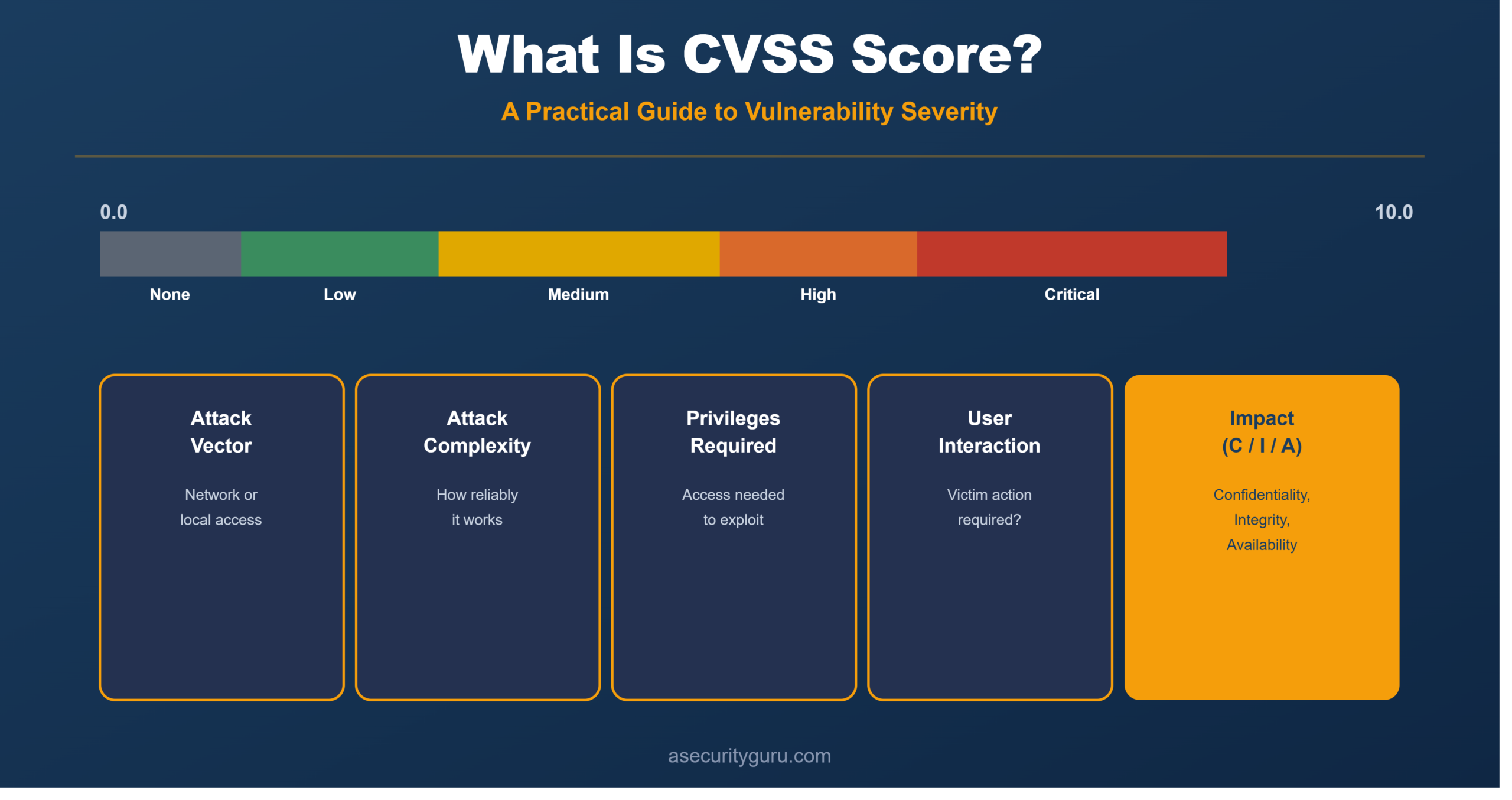
- What Is CVSS Score? — how vulnerabilities are rated based on their impact on confidentiality, integrity, and availability (CVSS impact metrics map directly to CIA)
- AI Security 101 — how the CIA Triad applies to AI systems, where new threat surfaces challenge each principle differently
For hands-on, structured learning across DevSecOps, Application Security, and AI Security — explore Raghu’s courses on Udemy.
Sources and References
- NIST Cybersecurity Framework (CSF 2.0) — foundational framework built on CIA Triad principles
- CISA Cybersecurity Resources — practical guidance on implementing security controls
- ASecurityGuru: What Is Cybersecurity?
- ASecurityGuru: Types of Cybersecurity Domains
Raghu the Security Expert has 20 years of experience in Security, DevSecOps, AI Security, and Penetration Testing. He has helped 80,000+ students upskill themselves in DevSecOps, Application Security, and AI Security. Follow his work on LinkedIn, YouTube, and Udemy.
That’s a really clear breakdown of the CIA triad. It’s amazing how foundational these concepts are to so much of cybersecurity work.