

Our organization developed an AI system and while performing Threat Modeling of this AI system, we used STRIDE as usual. When the external pen testing team performed the security assessment, it pointed out that threats like prompt injection and data poisoning had not been mitigated. This should have been caught during threat modeling. But because STRIDE doesn’t cover these categories, we missed it completely. That experience is exactly why STRIDE alone isn’t enough anymore for threat modeling agentic AI systems.
🎥 Video Walkthrough:
Agentic AI is moving fast. What started as chatbots answering questions has evolved into systems that reason, plan, remember context across sessions, and carry out multi-step workflows with minimal human input — connecting to APIs, calling tools, and making decisions largely on their own.
That autonomy is exactly what makes agentic AI so useful, and exactly what makes it hard to secure with the tools most security teams already have. Traditional cybersecurity was built to protect infrastructure, databases, APIs, and applications — things with predictable, deterministic behavior. Agentic AI adds something fundamentally different: the reasoning behind the decisions has to be secured too, not just the software running it.
Why Traditional Security Falls Short Here
Firewalls, access controls, vulnerability scanners, and manual threat modeling all work well when an application behaves predictably — the same input produces the same output, every time. Agentic AI breaks that assumption. These systems store memory, call third-party APIs, retrieve external information, invoke tools, and make autonomous decisions based on reasoning rather than fixed logic. That creates a dynamic, constantly shifting attack surface that traditional security tooling was never designed to fully understand.
Here’s a simple way to think about the difference: securing a traditional application is like locking the doors of a library to protect the books inside. Securing an autonomous AI agent is more like making sure the librarian can’t be talked into handing over the building’s blueprints, or convinced to hand out information they were never supposed to share in the first place.
That shift means security now has to evaluate an AI system’s reasoning and behavior, not just its application components.
A Dual-Track Approach: Agentic vs. Non-Agentic Components
Modern AI architectures benefit from a clear separation between two categories of components, each of which needs a different security approach.
| Aspect | Non-Agentic Components | Agentic Components |
| Purpose | Traditional application and infrastructure components performing predefined operations | AI-driven components that reason, plan, and execute autonomous tasks |
| Key components | UI, databases, authentication systems, APIs, traditional backend services | AI reasoning engines, planning modules, memory systems, tool execution layers, foundation models (LLMs), autonomous workflows |
| System behavior | Predictable, deterministic, rule-based | Dynamic, adaptive, capable of autonomous decisions |
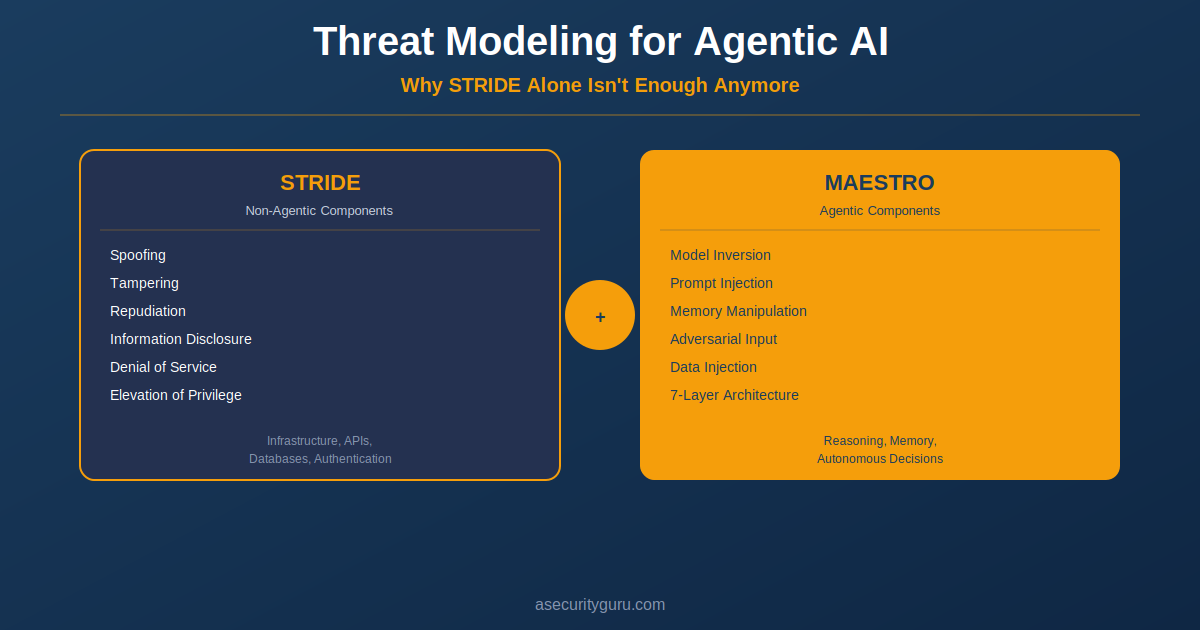
| Primary security framework | STRIDE | MAESTRO |
| Threat focus | Infrastructure vulnerabilities, authentication flaws, API security, data flow issues | Prompt injection, model inversion, memory manipulation, adversarial input, data injection |
STRIDE remains the right tool for the infrastructure and application layer — it was built for exactly that, and it still works well there. But it wasn’t designed to evaluate an AI system’s reasoning process, memory, or autonomous decision-making — which is the gap MAESTRO is built to close.
The Seven Layers of Agentic AI
Agentic AI isn’t a single black box — it’s made up of several layers that constantly interact during the reasoning process. The MAESTRO framework maps security assessment across all seven:
- Foundation Models — the underlying LLM the agent is built on
- Agent reasoning components — the logic that interprets context and decides what to do
- Internal subcomponents — the supporting logic and modules within the agent
- Memory systems — short-term and long-term context the agent retains
- External services and APIs — the tools and systems the agent connects to
- Application services — the surrounding application layer
- User-facing application layer — where the human actually interacts with the system
Looking at security this way — layer by layer — lets architects see how information actually moves through the system, where decisions get made, and where vulnerabilities are likely to show up. That’s a meaningfully different view than relying on perimeter defenses alone, and it surfaces risks that a standard infrastructure assessment simply wouldn’t catch.
Why Manual Threat Modeling Doesn’t Scale Here
Manual threat modeling has served security teams well for a long time, and it still has a place. But the complexity of a real agentic system makes it increasingly impractical to rely on manually alone. A single enterprise AI agent might run autonomous processes, talk to dozens of APIs, retain long-term memory, and continuously adjust its own logic based on new data. Mapping every possible attack path by hand, across all of that, becomes genuinely unrealistic.
This is where automated, AI-aware threat modeling tools — like Maestro Sentinel — earn their place. By analyzing architecture descriptions, application components, existing security controls, the foundation model in use, and external integrations, these tools can surface AI-specific threats automatically. What used to take weeks of brainstorming and workshop sessions can now produce a structured risk assessment in minutes — often surfacing 35 or more distinct potential threats, categorized by severity (Critical, High, Medium), for a security team to work through.
Automation doesn’t replace judgment here — it removes the bottleneck of finding the risks in the first place, so the team’s time goes toward deciding what to actually do about them.
The Threats That Are Unique to Agentic AI
Autonomous AI systems introduce attack patterns that simply don’t exist in traditional software. A few of the most significant:
Model Inversion — At the foundation model layer, an attacker crafts carefully designed prompts to extract sensitive information the model may have absorbed during training. Rather than stealing a database directly, the attacker uses the model itself as the extraction point.
Prompt Injection — Malicious instructions get inserted into user input or content the agent retrieves, aiming to override its original instructions. A successful prompt injection can get an AI system to ignore safety rules, leak private information, or take actions it was never intended to take.
Memory Manipulation — As agentic systems increasingly rely on persistent memory to maintain context and personalize responses, that memory itself becomes an attack surface. An attacker who can inject false history into an agent’s memory can quietly influence its future decisions and reasoning.
Adversarial Input Manipulation — An agent can be functioning exactly as designed and still make a poor decision, because the input it received was deliberately constructed to exploit a weakness in how it reasons.
Data Injection — Autonomous agents frequently pull in external data. If that data source is malicious or has been tampered with, it can quietly corrupt the agent’s downstream reasoning and conclusions — without anyone necessarily noticing until later.
Automation Doesn’t Replace Security Expertise
Automated threat modeling is a force multiplier, not a replacement for experienced security judgment. A human security architect still needs to:
- Validate the threats the automated tool identifies
- Review and refine the suggested mitigations
- Mark existing protections as “Not Applicable” where they genuinely don’t apply
- Assign proper threat identifiers for tracking
- Prioritize what actually gets remediated first, based on real business risk
Raghu’s Expert Take
In my experience, the real answer to ‘how do you threat model an agentic AI system’ isn’t STRIDE or MAESTRO — it’s both, applied to the right layer. For the agentic part of the system, MAESTRO is suitable, and for non-agentic parts of the system, STRIDE is suitable. The outcome of both frameworks will help us identify all the threats that are applicable to an agentic AI system.
Frequently Asked Questions
Is MAESTRO meant to replace STRIDE?
No. They solve different problems. STRIDE remains well-suited for traditional infrastructure and application components. MAESTRO specifically covers the reasoning, memory, and autonomous decision-making layers that STRIDE was never designed to assess. Most real agentic systems need both, applied to the appropriate layer.
What’s the difference between prompt injection and model inversion?
Prompt injection tries to override an agent’s instructions to make it do something it shouldn’t. Model inversion tries to extract sensitive information the model absorbed during training, using carefully crafted prompts as the extraction method rather than attacking the underlying data directly. They target different things — behavior versus data exposure.
Do small teams really need automated threat modeling, or is manual enough?
For a simple, low-autonomy AI feature, manual threat modeling may still be sufficient. Once a system has meaningful autonomy — multiple tool integrations, persistent memory, multi-step autonomous workflows — the attack surface typically grows faster than a manual process can realistically keep up with.
Can memory manipulation attacks be detected after the fact?
It’s harder than detecting a single bad prompt, because the effects show up gradually in downstream decisions rather than as one obvious event. This is exactly why auditing what’s actually stored in an agent’s memory, and being deliberate about what’s allowed to persist, matters as a control in its own right.
Where does this fit with the OWASP LLM Top 10?
They overlap significantly — prompt injection and data/model risks appear in both. The OWASP LLM Top 10 is a strong general-purpose reference for common LLM vulnerabilities; MAESTRO goes further by mapping threats to the specific architectural layers of an autonomous, tool-using agent.
Next Steps
This post builds on the threat-surface framework introduced in AI Security 101 and the practical skills covered in
10 AI Security Skills Every Engineer Needs in 2026. If you’re securing AI systems that interact with your network and infrastructure,
AI for Network Security is a natural next read.
For structured, hands-on learning across AI Security and DevSecOps, explore Raghu’s courses on Udemy.
Sources and References
OWASP Top 10 for Large Language Model Applications — foundational reference for LLM-specific vulnerabilities
NIST AI Risk Management Framework — governance and risk framework referenced throughout AI security practice
ASecurityGuru: AI Security 101
ASecurityGuru: 10 AI Security Skills Every Engineer Needs in 2026
Video Walkthrough: Threat Modeling for Agentic AI
Raghu the Security Expert has 20 years of experience in Security, DevSecOps, AI Security, and Penetration Testing. He has helped 80,000+ students upskill themselves in DevSecOps, Application Security, and AI Security. Follow his work on LinkedIn, YouTube, and Udemy.