

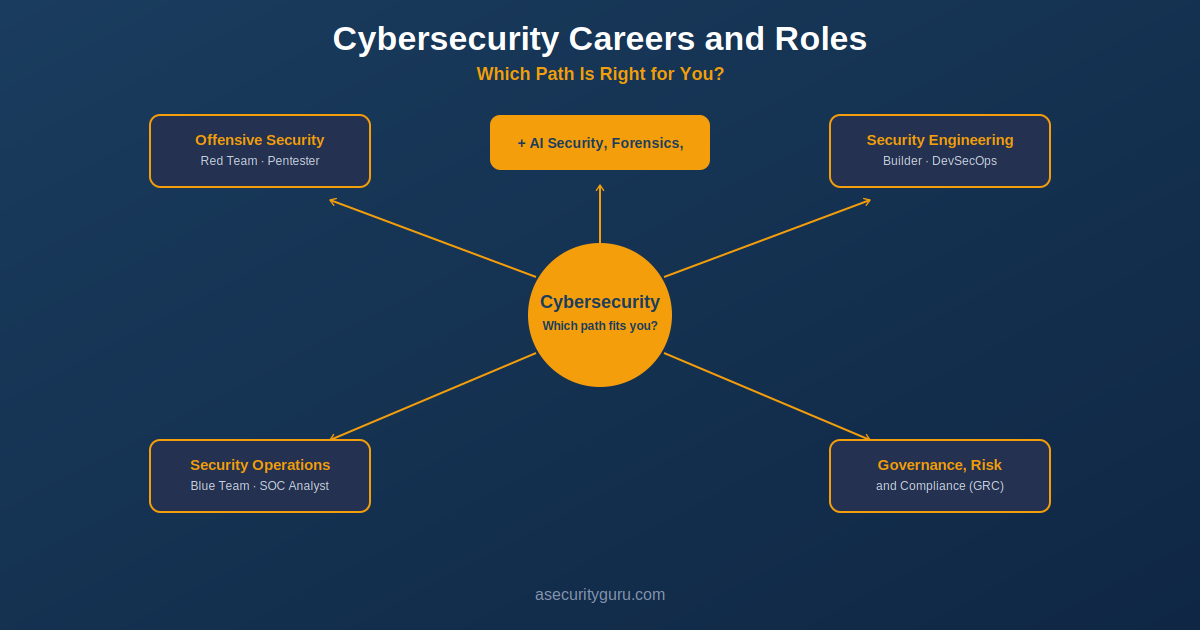
Cybersecurity is NOT only about securing code or penetration testing, it is far more beyond. I wish someone had told me that when I wanted to learn about Cybersecurity and there was no guidance available. Cybersecurity career options are broad and wide. If you don’t know coding, then there is still a career option for you in Cybersecurity as well. In this post, we will break down all these details while starting from basics.
Cybersecurity is the practice of protecting computer systems, networks, devices, and data from unauthorized access, damage, theft, or disruption. It combines technology, processes, and people to defend against threats like hacking, malware, phishing, and data breaches — covering everything from securing a single laptop to protecting an entire organization’s infrastructure. Think of it like this: just as we lock our homes to keep them safe, cybersecurity is putting digital locks on the internet-connected parts of our lives.
But “cybersecurity” isn’t one job — it’s an entire field of very different disciplines, and the path that suits you depends heavily on how you think and what kind of work actually holds your attention. An Ethical Hacker looks for weaknesses in a company’s systems so they can be fixed before an actual attacker finds them. A Security Analyst does the opposite kind of work — continuously monitoring systems, configuring firewalls, running vulnerability scans, and stopping suspicious activity before it becomes an incident. Neither is “better.” They’re different mindsets entirely, and figuring out which one fits you is the real starting point for a cybersecurity career.
Core Cybersecurity Career Paths
- Security Operations & Analysis — a security analyst’s job is to ensure computer systems remain secure and that no external threats can harm them.
- Penetration Testing — an expert tries to hack into your computer system, but only to find weaknesses so they can be fixed before a real hacker causes damage.
- Security Engineering & Architecture — a cybersecurity engineer builds and implements the tools and controls that keep computers and networks safe from the start.
- Incident Response & Digital Forensics — how organizations respond when a cyber-attack happens, to minimize damage and get things back to normal.
- Governance, Risk, and Compliance — making sure a company follows the rules and laws that keep its information safe, while managing the risks that come with it.
A Closer Look at Each Track
1. Security Operations (Blue Team)
- SOC Analyst (Tier 1–3) — monitors alerts, triages incidents, escalates threats. The most common entry point into cybersecurity.
- Incident Responder — investigates and contains active breaches; forensics-adjacent work.
- Threat Hunter — proactively searches for hidden threats that automated tools missed.
Good fit if you like pattern recognition, calm-under-pressure investigation, and real-time defence.
2. Offensive Security (Red Team)
- Penetration Tester — simulates attacks on systems, networks, and applications to find weaknesses before real attackers do.
- Red Team Operator — runs longer, stealthier simulated campaigns against an organization’s full defences.
- Bug Bounty Hunter — independent, freelance-style vulnerability hunting for rewards.
Good fit if you enjoy creative problem-solving, love breaking things methodically, and don’t mind writing detailed reports afterward.
3. Security Engineering / DevSecOps
- Security Engineer — builds and hardens infrastructure: firewalls, WAFs, IAM, cloud security controls.
- Application Security Engineer — reviews code, runs SAST/DAST tools, works closely with developers.
- Cloud Security Engineer — specializes in securing AWS, Azure, and GCP environments, increasingly in demand.
Good fit if you’re a builder at heart — you’d rather architect defences than just find or fix single incidents. For a detailed look at what this actually looks like day to day, see What Does a Security Engineer Actually Do?
4. Governance, Risk & Compliance (GRC)
- Risk Analyst — assesses and quantifies organizational security risk.
- Compliance Officer — ensures adherence to standards (SOC 2, ISO 27001, HIPAA, PCI-DSS).
- Security Auditor — independently verifies controls are actually working.
Good fit if you like structure, policy, and translating technical risk into business language.
5. Specialized and Emerging Tracks
- Malware Analyst / Reverse Engineer — dissects malicious software.
- Digital Forensics Investigator — reconstructs what happened after a breach, often working with law enforcement.
- Cryptographer — designs and analyses encryption systems (research-heavy, fewer roles).
- AI Security Engineer — a fast-growing niche securing ML models and AI pipelines against adversarial attacks. See AI Security 101 for what this specialization actually covers.
Typical Entry Points
- No experience? IT helpdesk or sysadmin roles are still the most common on-ramp, followed by a lateral move into a SOC analyst position.
- CS or technical background? You can often go straight into AppSec, security engineering, or junior penetration testing roles.
- Certifications that actually matter early on: CompTIA Security+ (entry level), then specialize — OSCP for offensive roles, GCIH or GCFA for blue team and forensics work, CISSP once you have experience (it requires 5 years in the field for full certification), and CCSP or cloud-specific certifications for cloud security.
Raghu’s Expert Take
If you don’t know where to start in cybersecurity, first ask yourself: ‘What am I most excited about — finding bugs in a system, or auditing one?’ Once you find your interest, you can choose the right career path in cybersecurity.
Frequently Asked Questions
Do I need a computer science degree to start a cybersecurity career? No — while a CS or related degree can help, many successful security professionals come from other technical backgrounds (IT support, networking, QA) or from bootcamps and self-directed learning combined with hands-on labs and certifications. What matters most is demonstrable, practical skill.
Which cybersecurity path pays the most? Compensation varies significantly by region, company, and seniority rather than by path alone. In general, specialized and senior roles — security architecture, offensive security leadership, and AI security — tend to command higher compensation as the field matures and demand outpaces supply.
Can I switch between these career paths later? Yes, and it’s common. Many professionals move between SOC work, penetration testing, and security engineering over the course of a career, since the underlying knowledge overlaps significantly. GRC transitions are a bit more distinct, but technical GRC professionals with security engineering or SOC backgrounds are especially valued.
Is penetration testing the same as ethical hacking? They’re closely related and often used interchangeably. Penetration testing is typically a more formal, scoped engagement with a defined methodology and deliverable report, while “ethical hacking” is a broader term that can also include bug bounty work and independent security research.
What’s the fastest way to find out which path suits me? Hands-on exposure. Try a home lab, a capture-the-flag challenge, or a free vulnerable-app environment for offensive work; try reviewing an application’s architecture for design-focused work; try shadowing or reading real incident reports for response-focused work. The path that keeps your attention during hands-on practice is usually the right signal.
Next Steps
If Security Engineering sounds like your path, What Does a Security Engineer Actually Do? A Day in the Life goes deep on what the role actually looks like. If AI Security is where you want to specialize, start with AI Security 101. For the foundational principles that apply across every path in this post, see Core Security Principles Every Engineer Should Know and The CIA Triad Explained.
For structured, hands-on learning across DevSecOps, Application Security, and AI Security, explore Raghu’s courses on Udemy.
Sources and References
- CompTIA Security+ Certification
- (ISC)² CISSP Certification
- NICCS / CISA: NICE Cybersecurity Workforce Framework
- OffSec: PEN-200 / OSCP Certification
- ASecurityGuru: What Does a Security Engineer Actually Do?
- ASecurityGuru: AI Security 101
Raghu the Security Expert has 20 years of experience in Security, DevSecOps, AI Security, and Penetration Testing. He has helped 80,000+ students upskill themselves in DevSecOps, Application Security, and AI Security. Follow his work on LinkedIn, YouTube, and Udemy.
That’s a really helpful breakdown of the different cybersecurity roles. I’ve been looking into penetration testing specifically, it seems like a really challenging and rewarding field.