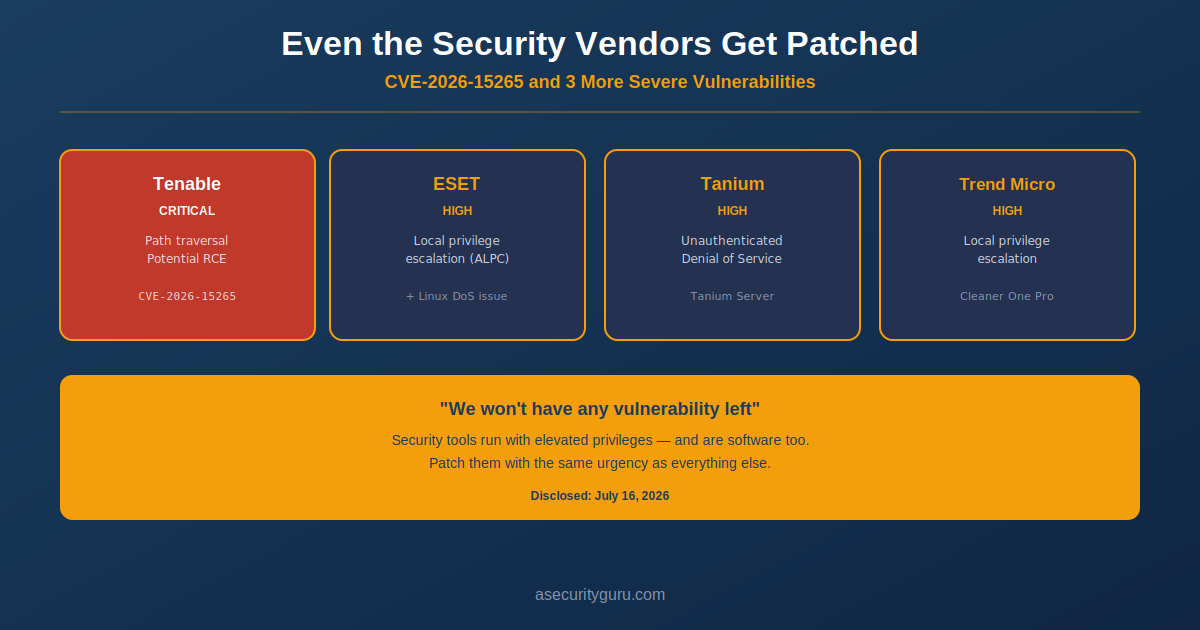
CVE: 2026-15265 Vendors affected: Tenable, ESET, Tanium, Trend Micro Disclosed: July 16, 2026 Highest severity: Critical (Tenable Agent — path traversal, potential RCE)
I remember a discussion with my client when they were saying “Let’s get Tenable Nessus tool in our infrastructure, we won’t have any vulnerability left”. I smiled and said “That’s not how it works”. Installing a security tool doesn’t mean these tools are 100% free from security vulnerabilities and can identify all kind of zero day attacks. Even these vendor tools also get breached.
There’s a specific kind of irony in a security vendor patching a vulnerability in its own product — the tool bought specifically to reduce risk becomes, for a moment, a source of it. On July 16, 2026, that irony played out four times over: Tenable, ESET, Tanium, and Trend Micro all disclosed and patched severe vulnerabilities in their security products on the same day.
None of these are confirmed to be under active exploitation yet. But that’s exactly the point of this post — these vulnerabilities matter before exploitation starts, not after, and the pattern across all four says something worth understanding regardless of which vendor you run.
What Was Actually Patched
Tenable Agent — Critical, path traversal (CVE-2026-15265)
A path traversal vulnerability in Tenable Agent that could potentially lead to remote code execution. This is the most severe of the four disclosures. Tenable Agent runs on endpoints specifically to perform vulnerability scanning — meaning the tool deployed to find vulnerabilities across your environment had one of its own, with the most serious possible outcome (RCE) on the table.
ESET Inspect Connector for Windows — High, local privilege escalation
A high-severity local privilege escalation vulnerability, exploitable through abuse of unauthenticated ALPC (Advanced Local Procedure Call) requests. ESET also patched a separate, lower-severity denial-of-service issue affecting its Linux product line in the same disclosure window.
Tanium Server — High, unauthenticated denial-of-service
An unauthenticated DoS vulnerability in Tanium Server. Tanium is widely used for real-time endpoint visibility and management at scale — a successful DoS against the server component doesn’t leak data, but it can blind a security team’s visibility into their own environment at exactly the moment they’d need it most.
Trend Micro Cleaner One Pro — High, local privilege escalation
A high-severity local privilege escalation vulnerability in Trend Micro’s Cleaner One Pro consumer product.
Why “It’s a Security Product” Isn’t a Reason to Relax
Security tools run with elevated privileges almost by necessity — an endpoint agent needs deep visibility into the system to do its job, a vulnerability scanner needs broad access to actually scan for problems, an EDR product needs kernel-level hooks to catch sophisticated threats. That’s not a design flaw; it’s the whole point of the product.
But it also means a vulnerability in a security tool can be more consequential than an equivalent vulnerability in an ordinary application, precisely because of the elevated access it already holds. A local privilege escalation bug in a random utility app is bad. A local privilege escalation bug in a product that already runs with deep system access is a shorter path to full compromise.
This is the same “who watches the watchmen” problem across security tooling generally — and it’s not new. Security vendors patch vulnerabilities in their own products regularly; it doesn’t mean the products are poorly built, it means they’re software, and all software has vulnerabilities eventually. The real signal isn’t “a security vendor had a bug” — it’s how fast they disclosed and patched it, and whether you actually apply that patch promptly.
What You Should Actually Do
If you run any of these products:
- Tenable Agent — patch immediately; this is the Critical-severity, RCE-potential issue and should be treated with the same urgency as any other Critical finding in your environment, regardless of the vendor
- ESET Inspect Connector (Windows) and ESET Linux products — apply both patches; don’t assume the DoS issue is low priority just because it’s not RCE — availability matters too
- Tanium Server — patch to restore assurance that your endpoint visibility can’t be knocked offline by an unauthenticated request
- Trend Micro Cleaner One Pro — patch, particularly relevant for consumer/prosumer deployments
More broadly, this is a good prompt to check: do your patch management processes actually cover your security tooling itself, or does “patch the environment” implicitly mean “patch everything except the security agents, because we trust those”? If it’s the latter, that’s a gap worth closing.
Raghu’s Expert Take
Security scanning tools themselves are subject to security vulnerabilities and it is very important that these tools run on hardened systems with role based access controls (RBAC). When a zero-day vulnerability is found in one of these tools, it should be patched as soon as the vendor releases a fix.
Frequently Asked Questions
Are any of these four vulnerabilities being actively exploited? Based on current reporting, none of the four newly disclosed vulnerabilities are confirmed to be under active exploitation. However, both Trend Micro and Palo Alto Networks have had other, separate products exploited in the wild recently — a reminder that the broader security tooling category is a real target for attackers, not just theoretical.
Why would attackers specifically target security software? Security tools often run with elevated privileges and broad visibility across an environment, which makes them high-value targets. Compromising a security agent can give an attacker the same deep access the tool itself was designed to have — plus the added benefit of potentially disabling or blinding the very tool meant to detect them.
Does this mean I shouldn’t trust security vendor products? No — it means all software, including security software, needs the same patch discipline as everything else in your environment. Avoiding security tools because they occasionally have vulnerabilities would leave you with far less visibility and protection overall. The right response is prompt patching, not avoidance.
How can I find out if my organization is running vulnerable versions of these products? Check each vendor’s official security advisory page directly (linked in Sources below) for the specific patched version numbers, and cross-reference against your current deployed versions through your asset inventory or the vendor’s own management console.
Where can I track vulnerabilities like these as they’re disclosed? Check the CVE Tracker for live CVSS scores and details on newly published CVEs, including vulnerabilities affecting security tooling.
Next Steps
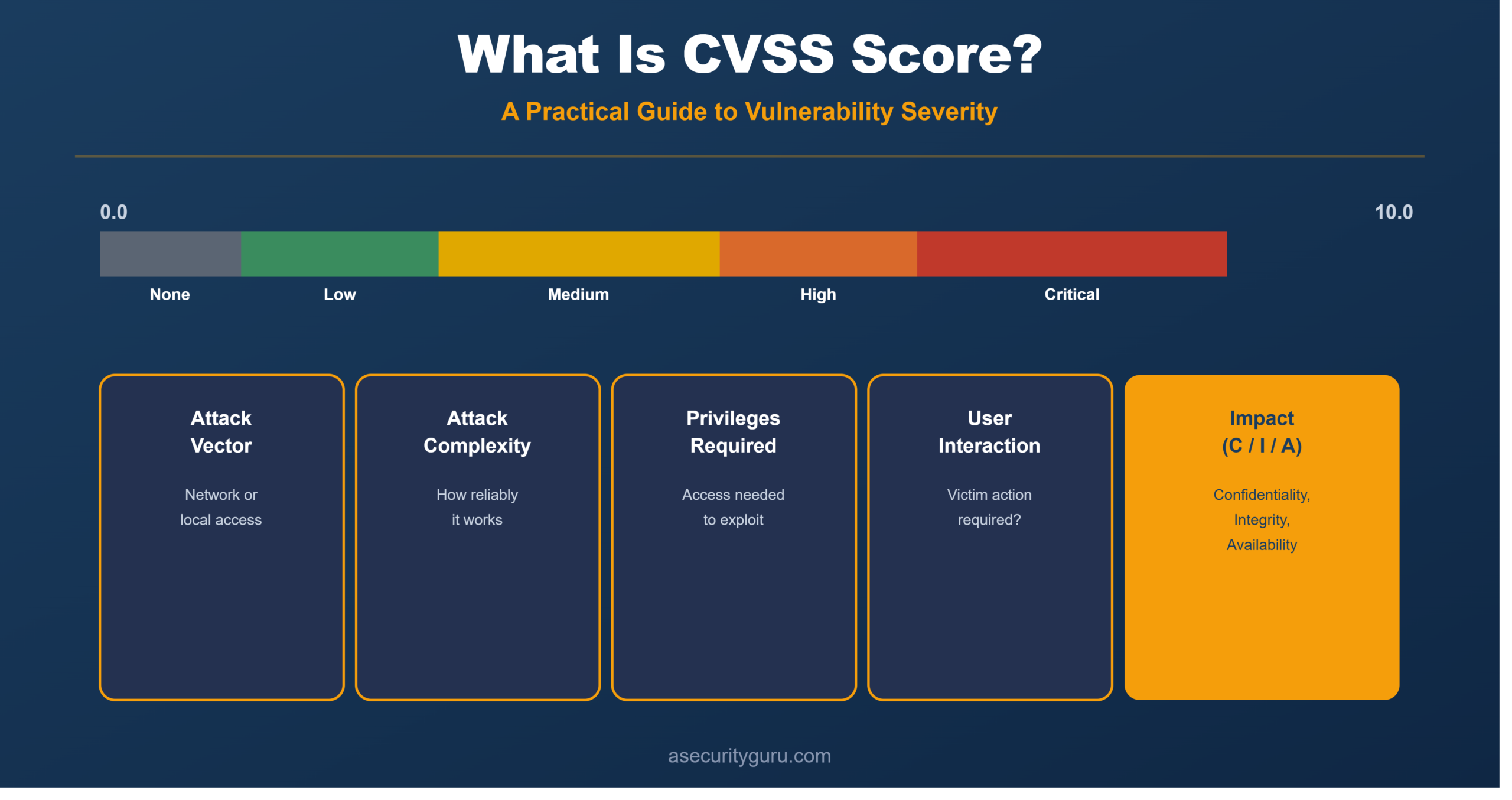
For a deeper understanding of how vulnerabilities like these get scored and prioritized, see What Is CVSS Score? Severity Ratings Explained. For the layered-defense principle that explains why no single security tool — including the ones with vulnerabilities discussed here — should be your only line of defense, see Core Security Principles Every Engineer Should Know.
For structured, hands-on learning across DevSecOps, Application Security, and AI Security, explore Raghu’s courses on Udemy.
Sources and References
- SecurityWeek: Trend Micro, Tanium, ESET and Tenable Patch Severe Product Vulnerabilities — original reporting on all four disclosures
- Tenable Security Advisories — official patch and advisory page
- ESET Security Advisories — official patch and advisory page
- Tanium Security Advisories — official patch and advisory page
- Trend Micro Security Advisories — official patch and advisory page
- ASecurityGuru: What Is CVSS Score?
- ASecurityGuru: Core Security Principles Every Engineer Should Know
Raghu the Security Expert has 20 years of experience in Security, DevSecOps, AI Security, and Penetration Testing. He has helped 80,000+ students upskill themselves in DevSecOps, Application Security, and AI Security. Follow his work on LinkedIn, YouTube, and Udemy.