

AI network security has become essential because attackers move faster than humans can review logs. AI for Network Security changes the equation on both sides. It helps defenders detect anomalies in real time, but it also lowers the barrier for attackers to automate reconnaissance and adapt mid-attack. This post covers how AI actually works for network defense, where it falls short, and the dual-use risk every engineer should understand.
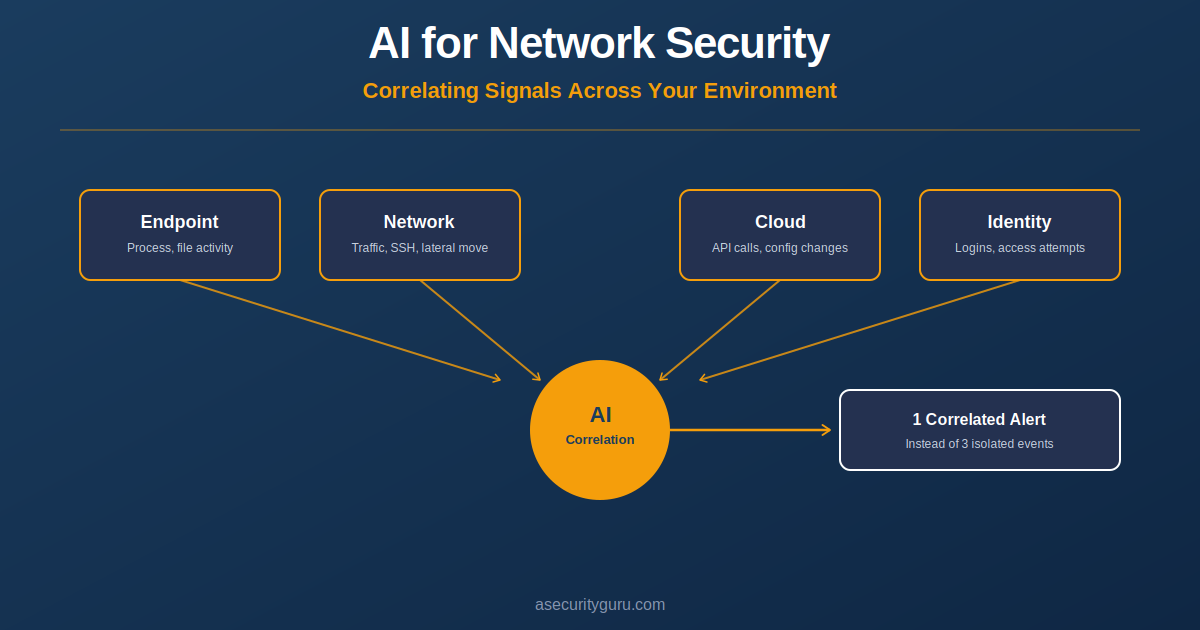
Our organization uses AI for Network security. That day in the office, our AI detection system created an alert, I was monitoring the alerts. When I received that alert, I was confused. The severity of the alert was Critical, description of the alert was “3 events were correlated by the AI system”. I immediately opened it and details were:
- In the 1st event, user tried to log in to the system but had a failed login attempt.
- In the 2nd event, user was able to log in to the system and tried to access a sensitive file.
- In the 3rd event, user sshed from one server to another and to another.
To me, it was 3 different events but to AI it was 1 alert. AI correlated these 3 events, identified that a user account was compromised and someone tried to brute-force their way into that system using that account successfully and then was moving across the network.
We immediately blocked that user account otherwise it could have been a disaster for us, phew, that was close.
How AI Actually Detects Threats on the Network
Traditional tools match known patterns — signatures of attacks that have already been seen before. AI instead builds a baseline of “normal” traffic per user, device, and application, then flags deviations from that baseline — catching threats that have never been seen before.
Modern AI-driven detection correlates signals across endpoints, network traffic, cloud activity, and identity logs simultaneously. This is what allows detection windows to shrink from many minutes to under a couple of minutes in well-tuned deployments. The longer an attacker sits undetected inside a network, the more damage they can do, so faster anomaly detection directly reduces that window.
This is also the architectural pattern behind XDR (Extended Detection and Response) — unifying these signals into one view instead of relying on separate, siloed tools.
The Other Side: How Attackers Are Using AI Too
AI is not a strictly defensive technology. Attackers use it too.
AI can map a target network’s structure and weak points far faster than manual reconnaissance ever could. It also enables adaptive, living-off-the-land techniques — generating commands that mimic legitimate admin activity, making detection harder.
A newer pattern worth watching: attackers plant malicious instructions in public places like GitHub issues, documentation, or code comments – a form of prompt injection.. An organization’s own AI agents pick these up and get tricked into executing unauthorized actions on the very network they’re supposed to be defending.
AI doesn’t just speed up your defense — it speeds up everyone’s offense too. The real shift in 2026 isn’t AI vs. no AI. It’s whose AI is faster and better governed.
Why AI Agents on Your Network Are a New Insider Threat
As organizations deploy AI agents for SOC automation, IT operations, or customer-facing tools, those agents often carry elevated, standing privileges to do their jobs. An agent that’s always on, never sleeps, and is implicitly trusted is a different risk profile than a human employee with the same access. If it’s compromised or manipulated — through prompt injection, for example — it can move through a network in minutes, far faster than a human attacker could.
A few practical controls:
- Enforce least privilege specifically for AI agents, not just human accounts
- Layer MFA, segmentation, and behavioral monitoring so a compromised agent doesn’t have a clear path through the network
- Regularly audit what permissions any AI tool or MCP server actually has, not just what it was provisioned with at setup
When we were reviewing an AI tool setup and its integration with other systems in the organization, we noticed that the service account used for this integration was part of the root group. Secondly, its password was set to never expire. We immediately alerted the team to setup a service account with least privilege and to stop using this account.
Where to Start
For a team with no AI-driven detection yet: start by mapping repetitive, well-understood detection and triage tasks that are good candidates for AI assistance — don’t start with full autonomy. Keep a human in the loop for any action that has real-world consequences, like isolating a host, revoking access, or blocking traffic, until the system has a track record.
Treat a new AI agent like a new hire on probation — feed it feedback, monitor its decisions, and only expand its access as it proves reliable. And remember: securing the AI tooling itself (the model, its data, its deployment) is a prerequisite to trusting its output on your network at all.
Frequently Asked Questions
Does AI replace the need for a human SOC team? No. AI accelerates detection and triage, but human analysts still validate findings, handle novel or ambiguous situations, and make final calls on high-impact actions.
What’s the difference between AI-driven detection and traditional signature-based detection? Signature-based detection matches known attack patterns. AI-driven detection builds a behavioral baseline and flags deviations from it, which means it can catch attacks that have never been seen before.
Can attackers use the same AI tools defenders use? Yes. AI is dual-use — the same techniques that speed up threat detection also speed up reconnaissance, phishing content generation, and adaptive evasion for attackers.
What is XDR and how does it relate to AI-driven network security? XDR (Extended Detection and Response) unifies signals from endpoints, network, cloud, and identity into a single view, which is the foundation AI needs to correlate threats across an environment rather than looking at isolated alerts.
What’s the biggest risk of deploying AI agents inside a corporate network? Standing, elevated privileges combined with implicit trust. A compromised or manipulated agent can act at machine speed with access a human attacker would have to work much harder to obtain.
Next Steps
If you want the broader threat-surface framework behind all of this, read AI Security 101: What Every Engineer Needs to Know in 2026. For hands-on skills, see 10 AI Security Skills Every Engineer Needs in 2026. For the latest CVEs affecting AI/ML frameworks, check the CVE Tracker.
Raghu the Security Expert has 20 years of experience in Security, DevSecOps, AI Security, and Penetration Testing. He has helped 80,000+ students upskill themselves in DevSecOps, Application Security, and AI Security. Follow his work on LinkedIn, YouTube, and Udemy.