

With the advent of AI, the Cyber criminals are using AI to attack systems, exploit application weakness and demand ransom for the stolen data. As AI has downside of getting used by attackers as well, we will establish “Why Cybersecurity Matters in 2026” or even after 2026.
In my organization, before AI, we used to get new CVEs once or twice a month and security teams used to work according to that pace to fix these CVEs if applicable to our systems. But recently, we are getting new CVEs identified within a week which is making our cybersecurity teams overwhelmed and the entire reason behind this increased attacks is Artificial Intelligence getting used by bad actors/Hackers as well.
This confirms that with the advent of AI, Cybersecurity jobs are going to increase and will be very important to ensure that our systems are safe from cybersecurity threats.
Secondly, the widespread integration of agentic AI and quantum computing has escalated cyber threats from isolated breaches to automated, systemic business risks. As security engineers, we also need to use AI to defend our systems and defending critical infrastructure along with sensitive data now requires dynamic, resilience-driven, and AI-powered protection models.
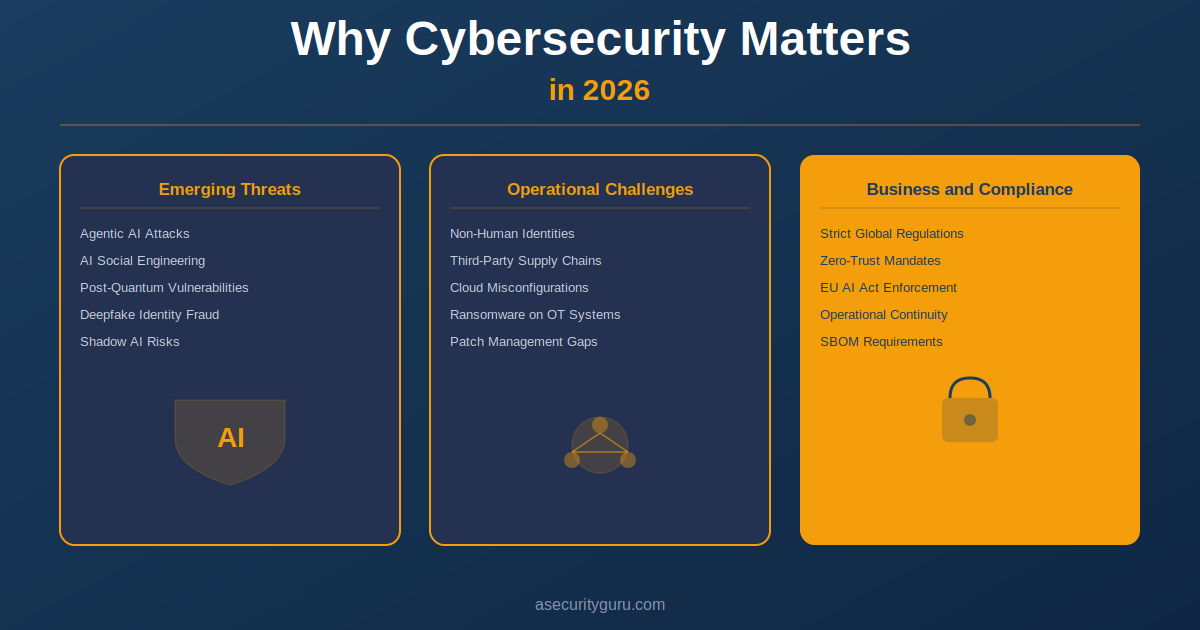
The cybersecurity risks in 2026 broadly spans across three domains that are:
- Emerging Threats — AI-driven attacks, post-quantum vulnerabilities, and social engineering at machine speed
- Operational Challenges — Non-human identities, third-party supply chains, and shadow AI
- Business and Compliance — Strict global regulations, zero-trust mandates, and operational continuity
The Top Threats Driving Cybersecurity in 2026
AI-Supercharged Social Engineering
Generative AI now acts as a force multiplier for attackers. Hyper-personalised deepfakes, automated phishing campaigns, and synthetic identity fraud are being generated at scale that was impossible just two years ago. The attacker no longer needs to be skilled — they need to be subscribed.
Agentic AI and Shadow AI
Employees are deploying AI tools without IT oversight — uploading sensitive data to consumer AI products, connecting unsanctioned AI agents to corporate systems, creating massive new attack surfaces. At the same time, AI agents deployed by security teams carry elevated privileges and never sleep, making them high-value targets if compromised.
Supply Chain Vulnerabilities
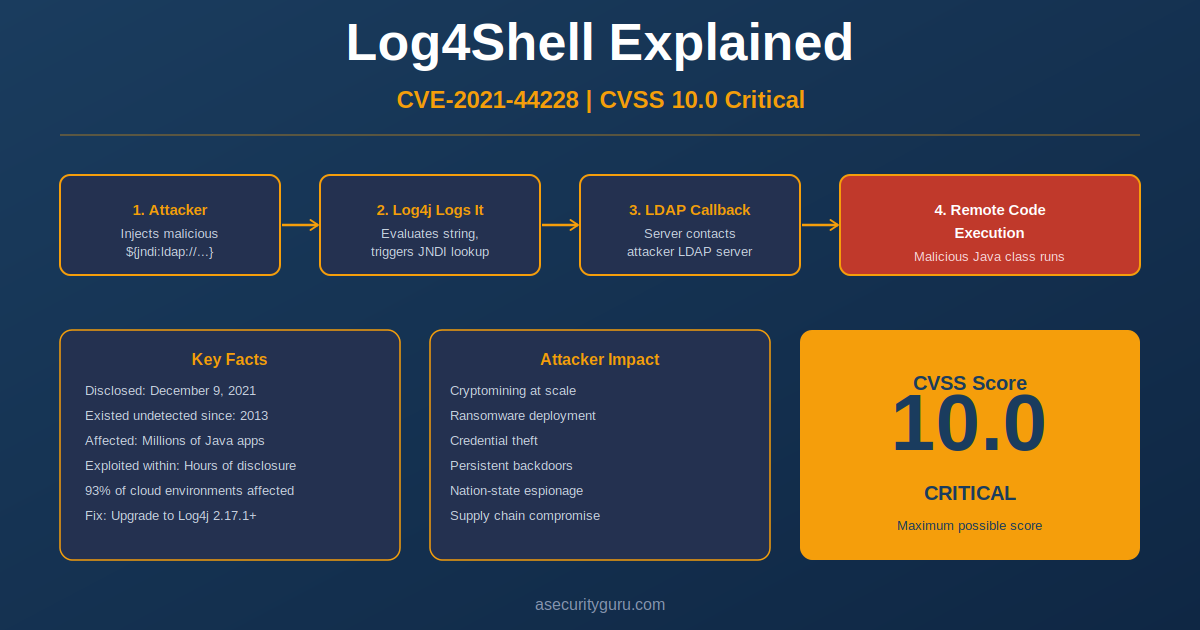
Interconnected business ecosystems mean a breach at a single trusted third-party vendor can cascade into an organisation’s entire network. The Log4Shell vulnerability (CVE-2021-44228) — a CVSS 10.0 flaw hidden in a library used by millions of Java applications — is the clearest example of how invisible dependencies become organisation-wide emergencies.
According to the IBM X-Force Threat Intelligence Index 2026, there is more than 40% increase in attacks on public facing apps, exploit creation and ransomware groups.
Critical Infrastructure Under Attack
Ransomware groups now actively target operational technology — hospitals, power grids, manufacturing plants — forcing extended shutdowns with real-world consequences that go far beyond data loss.
Quantum Readiness
Post-quantum cryptography is moving from a research topic to an operational priority. NIST released its first three post-quantum cryptography standards in August 2024 and recommends organisations begin migrating now. Classical encryption methods will eventually be breakable by sufficiently advanced quantum systems, and organisations that start preparing now — by inventorying their cryptographic dependencies — will be significantly better positioned than those that don’t.
Identity Management at Scale
With the explosion of non-human identities (AI agents, service accounts, automated pipelines) now outnumbering human users in many enterprises, traditional IAM models built around human users are no longer sufficient. Every AI agent and service account needs the same access governance as a human employee.
7 Cybersecurity Tips That Actually Matter in 2026
1. Use a Password Manager
Use a password manager (1Password, Bitwarden, or Dashlane) and generate unique, 20+ character passwords for every account. You only need to remember one master password — the manager handles the rest.
2. Enable Multi-Factor Authentication Everywhere
App-based MFA (Google Authenticator, Authy, Microsoft Authenticator) is far more secure than SMS-based codes, which can be intercepted via SIM-swapping. For your most critical accounts, go further with a hardware security key (YubiKey, Titan Key). Enable MFA on email, banking, social media, and all work accounts first.
3. Think Before You Click
If an email seems suspicious, don’t click links or download attachments. Go directly to the website by typing the URL yourself, or call the company using a number you look up independently — never one from the email itself.
4. Keep Everything Updated
Patch your operating system, browsers, mobile apps, router firmware, and IoT devices regularly. Most successful exploits target known vulnerabilities with available patches — update cycles are the primary window attackers rely on.
5. Back Up Your Data (3-2-1 Rule)
Three copies of your data, on two different media types, with one copy offsite. Automated cloud backup (Backblaze, Carbonite, iDrive) combined with a disconnected external hard drive covers this for most individuals and small teams. This is the single most underrated control — and the one most organisations skip testing.
6. Lock Down Your Privacy Settings
Review privacy settings on every social platform. Limit who can see your posts, friend list, and personal information. Turn off location tracking for apps that don’t need it, revoke permissions from apps you no longer use, and consider privacy-focused alternatives: DuckDuckGo for search, Signal for messaging, Proton Mail for email.
7. Be Careful on Public Wi-Fi
Use a VPN (NordVPN, ExpressVPN, or Mullvad) on any public network and avoid accessing banking or sensitive accounts. Turn off automatic Wi-Fi connection on your devices, and when possible use your phone’s hotspot instead.
The 4 C’s of Cybersecurity
A simple framework for thinking about your security posture:
- Change — Change default passwords, update software, rotate credentials regularly
- Harden — Use strong passwords, MFA, and encryption as standard
- Compartmentalise — Separate work and personal accounts; use guest networks for IoT devices
- Continuous — Security is an ongoing practice, not a one-time checklist
Raghu’s Expert Take
Don’t just think that if you have taken backups for your primary site, you can handle any ransomware attack and if you have patched your system, you are secure from all kinds of vulnerabilities. Because the need to stay vigilant and always ready to face the unseen, is greater now than ever before.
Cybersecurity isn’t about being paranoid — it’s about being prepared. The threats are real, but the defences are actionable. The organisations and individuals that get breached in 2026 won’t all be unlucky — many will simply have skipped steps they knew they should have taken.
Frequently Asked Questions
Is cybersecurity still a good career in 2026? Yes — and the demand is accelerating, not declining. AI is augmenting security teams rather than replacing them, creating new roles in AI security, threat hunting, and security engineering that didn’t exist five years ago.
Has AI started replacing cybersecurity professionals? AI is replacing repetitive tier-1 triage tasks, but it’s creating more work at higher levels of the stack — interpreting AI-generated alerts, governing AI agent access, and building AI-native defences. The professionals who understand AI security are among the most sought-after in the field right now.
Is cybersecurity becoming too saturated for beginners? Entry-level roles are more competitive than in previous years, but the field is far from saturated — particularly in AI security, cloud security, and DevSecOps, where the talent gap is significant. Beginners who focus on these high-growth areas have strong prospects.
What’s the biggest cybersecurity mistake organisations make in 2026? Treating AI tools as inherently trusted. Employees connect AI agents to production systems with excessive permissions, share sensitive data with consumer AI products, and deploy AI without understanding the new attack surfaces they’re creating.
Sources and References
- IBM X-Force Threat Intelligence Index 2026 — Supply chain compromises, ransomware surge, and public-facing application attack statistics
- NIST Post-Quantum Cryptography Standards — Post-quantum cryptography standards released August 2024
- CISA Known Exploited Vulnerabilities Catalog — Actively exploited CVEs targeting critical infrastructure
- ASecurityGuru: Log4Shell Explained (CVE-2021-44228) — Real-world CVSS 10.0 supply chain vulnerability case study
- ASecurityGuru: What Is Cybersecurity? — Foundational overview of cybersecurity domains and principles
Next Steps
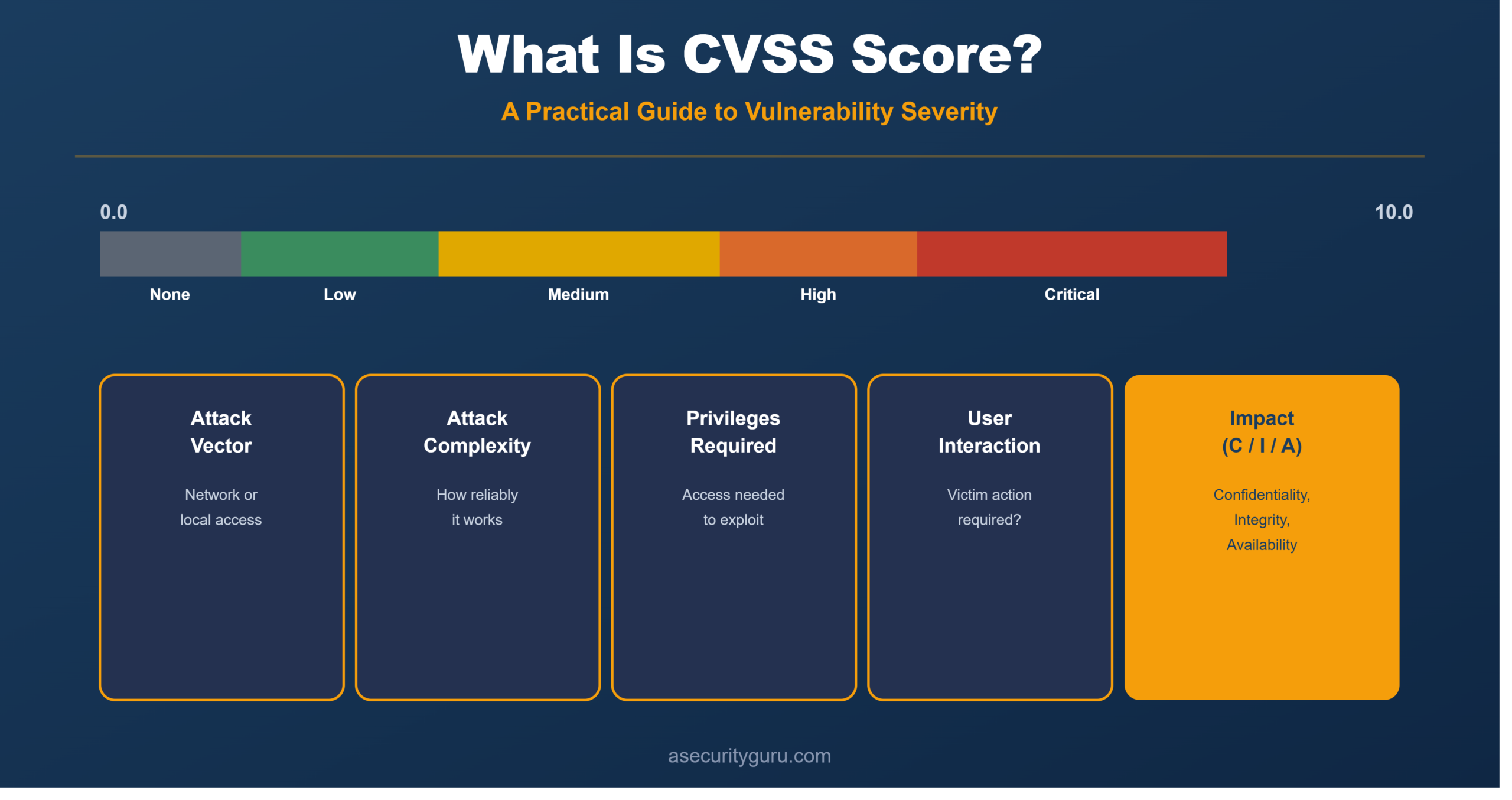
Understanding why cybersecurity matters is the first step. The next is understanding what the field actually covers and how to build skills in it. Start with What Is Cybersecurity? for the foundational overview, then explore specific domains — AI Security 101 if you’re focused on securing AI systems, or What Is CVSS Score? if you want to understand how vulnerabilities are rated and prioritised.
Raghu the Security Expert has 20 years of experience in Security, DevSecOps, AI Security, and Penetration Testing. He has helped 80,000+ students upskill themselves in DevSecOps, Application Security, and AI Security. Follow his work on LinkedIn, YouTube, and Udemy.
It’s really smart to be thinking about this now. The rise of AI is definitely going to change how we approach security risks.