Last week, when I was discussing a framework with a client for managing risks of an AI system, they thought ISO 42001 is the right framework for the organization. But when I explained the NIST AI RMF to them, they understood the actual need of the organization and agreed with me to implement the guidelines given in NIST AI RMF rather than going with ISO 42001. This made one thing very clear, picking the right framework starts with understanding the need of the organization.
A cybersecurity framework is a structured set of guidelines, standards, and best practices used to manage and reduce digital risk. It gives an organization a common, actionable blueprint for assessing vulnerabilities, protecting assets, and building resilience against cyberattacks — rather than every team inventing its own approach from scratch.
Components of a Cybersecurity Framework
Every cybersecurity framework consists of three essential components:
- Framework core — identifies required security controls and helps assess gaps between current and desired security levels.
- Implementation tiers — cover mission goals, risk tolerance, and cost considerations, and measure the maturity of cybersecurity practices.
- Profiles — define goals, assets, and risk priorities, letting an organization customize the framework to its context.
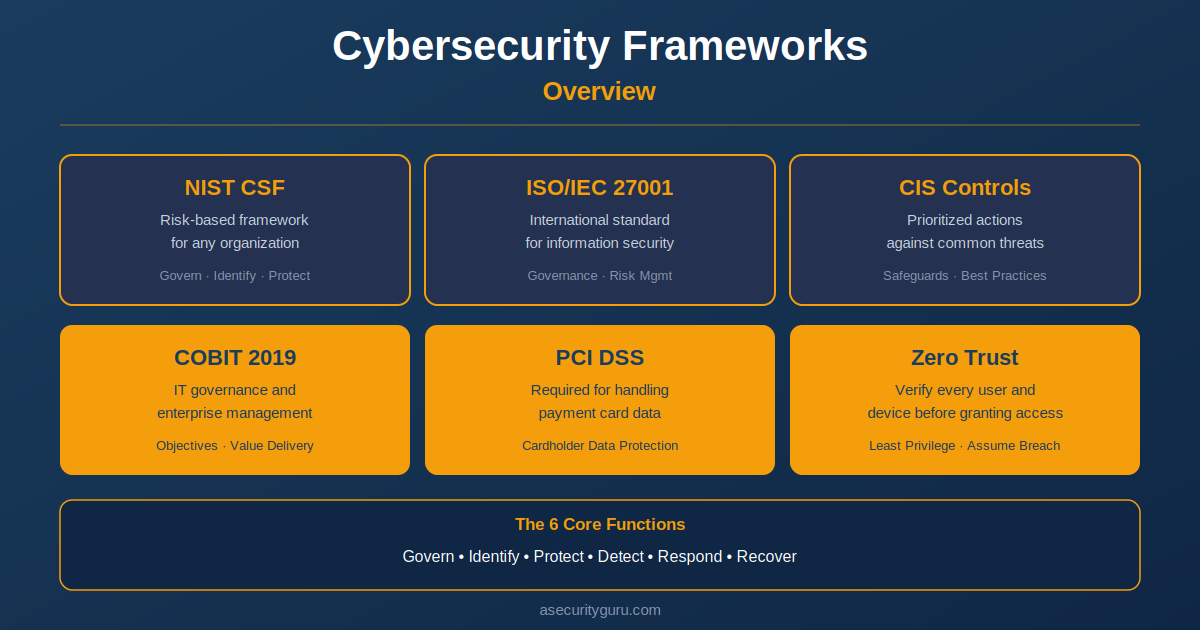
The 6 Core Functions
The framework core (based on the NIST Cybersecurity Framework 2.0) outlines cybersecurity outcomes across a continuous lifecycle:
- Govern — establishes and monitors the organization’s cybersecurity risk management strategy, policies, and oversight.
- Identify — catalogs assets (hardware, software, data) and assesses their associated risks and vulnerabilities.
- Protect — implements safeguards to secure systems and limit the impact of an event — access controls, encryption, staff training.
- Detect — monitors systems for suspicious activity and identifies cybersecurity events as they occur.
- Respond — executes prepared plans to contain incidents, mitigate damage, and communicate internally and externally.
- Recover — restores impaired assets and capabilities, continually improving the organization’s resilience.
Types of Cybersecurity Frameworks
1. Risk Management Frameworks
Help organizations identify, assess, and manage cybersecurity risks by evaluating threats and vulnerabilities and applying appropriate controls.
- NIST Risk Management Framework (RMF) — integrates security and risk management into system development. Read the NIST RMF documentation.
- ISO/IEC 27005 — guidelines for information security risk management aligned with ISO 27001.
2. Compliance Frameworks
Help organizations meet legal, regulatory, and industry security requirements — protecting sensitive data, avoiding penalties, and maintaining trust through defined rules and audit standards.
- GDPR — focuses on data privacy and protection in the EU.
- HIPAA — sets standards for protecting healthcare information in the US.
3. Control Frameworks
Provide structured security controls and best practices to protect systems, networks, and data.
- CIS Controls — prioritized actions to defend against common cyber threats. View the CIS Controls.
- NIST Cybersecurity Framework (CSF) — organized around Identify, Protect, Detect, Respond, Recover. View NIST CSF 2.0.
4. Governance Frameworks
Align cybersecurity and IT strategy with business objectives, focusing on accountability, decision-making structures, and effective management of IT resources and risk.
- COBIT — framework for IT governance and enterprise management. Explore COBIT (ISACA).
- ITIL — best practices for IT service management and value delivery.
5. Incident Response Frameworks
Guide organizations in preparing for, detecting, responding to, and recovering from cybersecurity incidents, minimizing damage and improving resilience.
- NIST SP 800-61 — Computer Security Incident Handling Guide. Read SP 800-61.
- SANS Incident Response Process — lifecycle-based approach covering preparation, detection, containment, recovery, and lessons learned.
Common Cybersecurity Frameworks at a Glance
- NIST Cybersecurity Framework — risk-based security guidelines for organizations of any size.
- ISO/IEC 27001 & 27002 — international standards for information security management. View ISO/IEC 27001.
- FISMA — US federal information security compliance framework.
- SOC 2 — security and privacy controls for service organizations.
- HIPAA — protects healthcare data and patient privacy.
- PCI DSS — required for organizations that handle payment card data. View PCI DSS.
Why Cybersecurity Frameworks Matter
Frameworks standardize security practices across the organization, reduce cybersecurity risk through structured and repeatable processes, help meet regulatory and compliance requirements, improve incident response and recovery, build customer and stakeholder trust, and support continuous improvement of the organization’s security posture.
Benefits of Cybersecurity Frameworks
Adopting a recognized framework establishes globally understood security standards, improves collaboration across systems, teams, and industries, reduces implementation cost through structured and reusable processes, provides flexible security models that scale with the organization, and strengthens overall cyber resilience and risk management.
Raghu’s Expert Take
If an organization just wants to harden the systems and they don’t have an in-house standard then CIS benchmarks can help them start system hardening at various levels, beginning with Level 1. If it is a banking/card organization, then PCI-DSS is the right framework for them. If they are looking to certify the organization and their systems, then ISO frameworks should be followed. So before selecting any framework, I would suggest to document the requirements of the organization.
Frequently Asked Questions
Is a cybersecurity framework the same as compliance? No. A framework is a tool for building security; compliance is proof that certain requirements were met, often assessed against a framework or regulation. Following a framework well should make compliance a natural byproduct rather than the end goal.
Which framework should a small business start with? The NIST CSF is a common starting point because it is sector-agnostic, free, and organized around plain-language functions (Govern, Identify, Protect, Detect, Respond, Recover) that scale from small teams to large enterprises.
Do frameworks replace the need for a security team? No. A framework provides structure and prioritization; it still requires people to implement, monitor, and adapt the controls it recommends.
Can an organization use more than one framework at the same time? Yes, and it’s common. Many organizations use NIST CSF as their overall risk management structure while also complying with a specific standard like PCI DSS (for payment data) or HIPAA (for healthcare data), since these frameworks address different scopes and often complement each other.
How does Zero Trust relate to these frameworks? Zero Trust is more of a security philosophy or architecture pattern than a formal compliance framework — it asserts that no user or device should be trusted by default, inside or outside the network. It’s frequently implemented as part of fulfilling the “Protect” function within NIST CSF or similar controls in other frameworks, rather than standing alone as a certifiable standard.
Next Steps
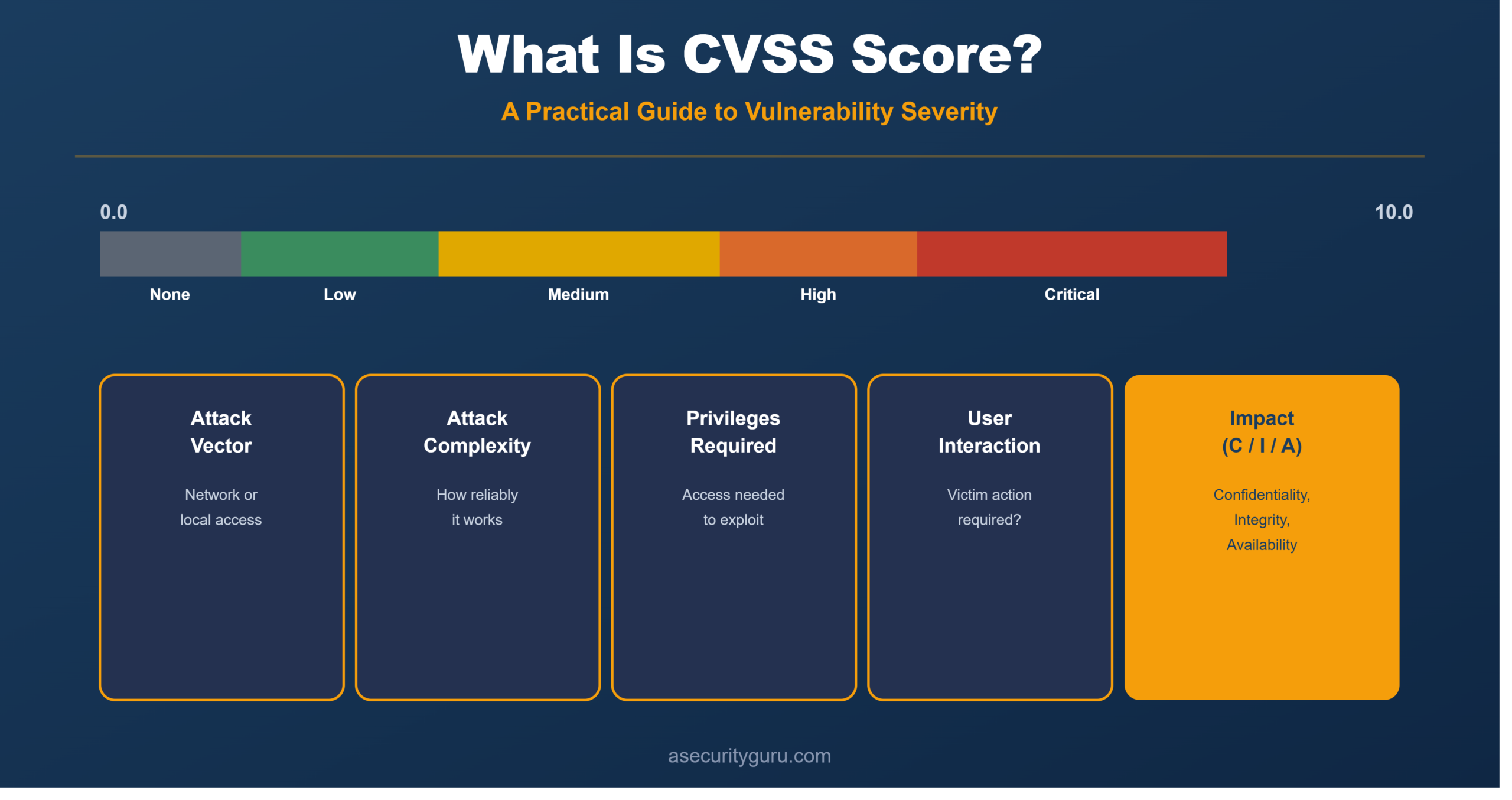
Understanding frameworks is the structural layer — Core Security Principles Every Engineer Should Know covers the practical, day-to-day principles (least privilege, defense-in-depth, Zero Trust) that these frameworks are built to enforce. For how vulnerability severity fits into a risk management framework’s prioritization, see What Is CVSS Score? Severity Ratings Explained.
For structured, hands-on learning across DevSecOps, Application Security, and AI Security, explore Raghu’s courses on Udemy.
Sources and Further Reading
- NIST Cybersecurity Framework (CSF 2.0)
- NIST Risk Management Framework (RMF)
- ISO/IEC 27001 Information Security
- CIS Controls
- COBIT Framework (ISACA)
- PCI Security Standards Council (PCI DSS)
- CISA Cybersecurity Resources
- NIST SP 800-61 Incident Response Guide
- ASecurityGuru: Core Security Principles Every Engineer Should Know
Raghu the Security Expert has 20 years of experience in Security, DevSecOps, AI Security, and Penetration Testing. He has helped 80,000+ students upskill themselves in DevSecOps, Application Security, and AI Security. Follow his work on LinkedIn, YouTube, and Udemy.