My friend Raghav, who is new to cybersecurity, was telling me that multi-factor authentication (MFA) is better than two-factor authentication (2FA). I asked him “Why do you think so” and he could not answer it. The reason is that people don’t understand the most common cybersecurity terminology at work and start working with clearing the basics. Even my mother knows about 2FA and was setting up password on her phone to make sure nobody can open her phone without her permission 🙂
Cybersecurity terminology is genuinely valuable for keeping your personal data safe. In your day-to-day life, knowing terms like “phishing” or “two-factor authentication” helps you spot scams and protect your online accounts from unauthorized access.
In a technical context, this shared vocabulary is essential for clear communication — it lets teams discuss vulnerabilities, implement appropriate security measures, and respond to incidents effectively. It forms the foundation for building strong and resilient systems.
Here’s a rundown of terms that come up often in cybersecurity, grouped by theme so they’re easier to hold onto.
Threats and Attacks
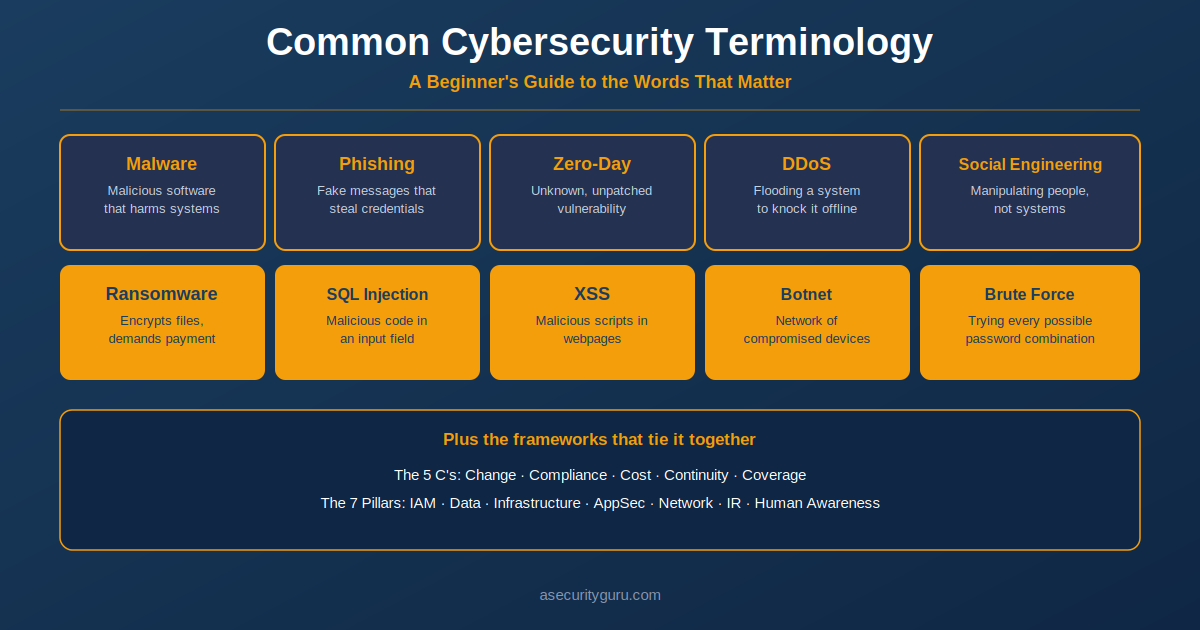
- Malware — Umbrella term for malicious software: viruses, worms, trojans, spyware, ransomware, etc.
- Ransomware — Malware that encrypts a victim’s files and demands payment for the decryption key.
- Phishing — Fraudulent messages (usually email) designed to trick someone into revealing credentials or installing malware. Spear phishing targets a specific person; whaling targets executives.
- Social engineering — Manipulating people (rather than systems) into giving up access or information.
- DDoS (Distributed Denial of Service) — Flooding a system with traffic from many sources to knock it offline.
- Zero-day — A vulnerability that’s unknown to the vendor (and unpatched) at the time it’s exploited.
- Man-in-the-middle (MitM) — An attacker secretly intercepts and possibly alters communication between two parties.
- SQL injection — Inserting malicious SQL code into an input field to manipulate a database.
- Cross-site scripting (XSS) — Injecting malicious scripts into webpages viewed by other users.
- Advanced Persistent Threat (APT) — A prolonged, targeted intrusion, often by well-resourced actors (nation-states, organized groups).
- Botnet — A network of compromised devices controlled remotely, often used for DDoS or spam.
- Brute force attack — Trying many password/key combinations until one works.
The 5 C’s of Cybersecurity
The 5 C’s of cybersecurity are a strategic framework that helps organizations build a robust defense system against threats, providing a holistic, organizational view of cyber defense:
- Change — Systems must constantly adapt to new threats and technologies through active patch management and change control procedures.
- Compliance — Organizations must adhere to data protection laws and industry standards (such as GDPR or HIPAA) to establish risk-based controls and avoid legal penalties.
- Cost — Reflects the financial investment required for effective cybersecurity tools and employee training, weighed against the catastrophic losses of a potential breach.
- Continuity — Emphasizes the importance of business continuity planning and incident response to ensure critical functions continue to operate during or immediately following a cyber crisis.
- Coverage — Ensures that security measures (like firewalls and multi-factor authentication) cover all aspects of an organization, including remote networks, third-party vendors, and all endpoint devices.
The 7 Pillars of Cybersecurity
- Identity and Access Management (IAM) — Ensures only authenticated users and trusted devices access your systems. It relies on the principle of least privilege, utilizing multi-factor authentication (MFA) and continuous monitoring.
- Data Protection — Secures sensitive information by classifying, cataloguing, and encrypting it. This pillar focuses on preventing data loss both at rest and in transit.
- Infrastructure and Endpoint Security — Safeguards all physical and virtual environments. This includes securing servers, cloud environments, and individual user endpoints (laptops, phones, and IoT devices) from vulnerabilities.
- Application Security — Focuses on the security of software, whether built in-house or sourced from third parties. It involves secure coding practices, regular vulnerability patching, and application firewalls.
- Network Security — Protects the pathways that data travels on. This involves using network segmentation (like micro-segmentation in a Zero Trust model), firewalls, and secure network protocols to prevent unauthorized access and lateral movement of threats.
- Incident Response and Monitoring — Prepares an organization to detect, respond to, and recover from security breaches. This includes continuous telemetry, security information and event management (SIEM) tools, and practiced incident response playbooks.
- Human Awareness — Empowers employees and users to act as a “human firewall.” This pillar minimizes human risk through regular security awareness training, phishing simulations, and promoting a strong security culture.
Raghu’s Expert Take
While talking to clients for a project proposal, it is very important that you are familiar with all the cyber security terms as it will help you to suggest the right solution for the problem being discussed. Clients appreciate vendors who are subject matter experts (SME) in their field and prefer to hire such vendors.
Frequently Asked Questions
What is malware? Malware is any software intentionally designed to damage, disrupt, or gain unauthorized access to systems.
What is phishing? Phishing is a social engineering attack that tricks users into revealing credentials or installing malware.
Why should beginners learn cybersecurity terms? Knowing common terminology helps you identify threats, follow security best practices, and communicate clearly with IT and security teams when something looks wrong.
What’s the difference between a vulnerability and an exploit? A vulnerability is a weakness in a system that could potentially be abused. An exploit is the actual code or technique used to take advantage of that weakness. Not every vulnerability has a known exploit, but every exploit targets a specific vulnerability.
Do I need to know all of these terms if I’m not a security professional? No — but knowing the ones that show up in everyday life (phishing, malware, MFA, data breach) goes a long way toward protecting your own accounts and recognizing scams. The more technical terms (SQL injection, XSS, APT) matter more if you’re working in IT, development, or security specifically.
Next Steps
This glossary pairs naturally with The CIA Triad Explained and Core Security Principles Every Engineer Should Know — both build directly on the vocabulary introduced here. For a structured way to think about which frameworks and standards these terms connect to, see Cybersecurity Frameworks Overview.
For structured, hands-on learning across DevSecOps, Application Security, and AI Security, explore Raghu’s courses on Udemy.
Sources and References
- OWASP Top 10 — reference for common web application vulnerabilities including SQL injection and XSS
- CISA Cybersecurity Resources — official guidance and terminology reference
- NIST Cybersecurity Framework (CSF) — foundational framework referenced throughout this glossary
- MITRE ATT&CK Framework — reference for adversary tactics including APTs and botnets
- OWASP Web Security Testing Guide — technical reference for application security testing
- ASecurityGuru: The CIA Triad Explained
- ASecurityGuru: Cybersecurity Frameworks Overview
Raghu the Security Expert has 20 years of experience in Security, DevSecOps, AI Security, and Penetration Testing. He has helped 80,000+ students upskill themselves in DevSecOps, Application Security, and AI Security. Follow his work on LinkedIn, YouTube, and Udemy.